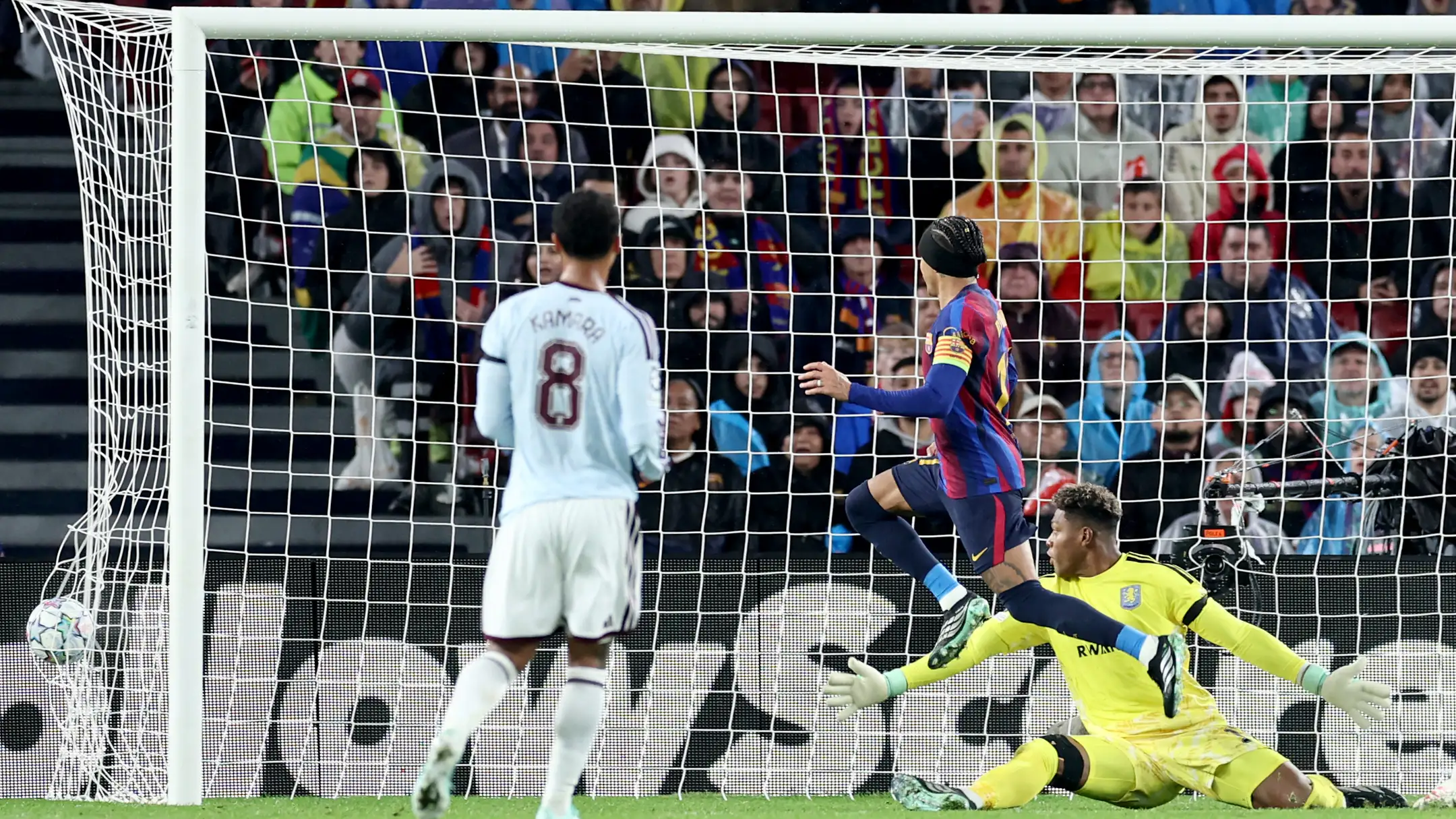

Barcelona secured a 3-0 victory over Aston Villa, with Hansi Flick's attacking approach proving too much for Unai Emery's defensive setup. Lamine Yamal opened the scoring in the seventh minute before Raphinha added two second-half goals to seal the result.
Key Highlights:
- Barcelona's 4-2-3-1 formation created attacking space for Lamine Yamal and allowed the full-backs to push forward.
- Aston Villa's compact defensive block struggled to contain Barcelona's movement and counter-pressing.
- Raphinha's freedom to move into central areas helped Barcelona exploit gaps behind Villa's defensive line.
- Flick's half-time and second-half substitutions helped Barcelona maintain control and secure a 3-0 win.
Barcelona's Tactical Setup
Hansi Flick deployed Barcelona in a 4-2-3-1 formation that shifted into a 2-3-5 shape when the team had possession. Rodri and Fermin Lopez operated as the double pivot, allowing full-backs Joao Cancelo and Gerard Martin to push higher and provide width.
One of Barcelona's main attacking aims was to create one-on-one opportunities for Lamine Yamal on the right flank. The approach paid off in the seventh minute when Yamal found the breakthrough by exploiting space on Villa's left side.
Barcelona also applied an aggressive pressing strategy. Whenever the ball reached Villa's double pivot of Kamara and Gomes, the hosts' front four initiated a coordinated press, forcing the visitors to play long passes that Pau Cubarsi could deal with.
Pedri played a key role in Barcelona's build-up, regularly dropping between the lines to help move the ball forward. Raphinha, meanwhile, started on the left but frequently moved into central areas to operate closer to the striker. His movement, combined with Fermin Lopez's decoy runs, helped create the openings behind Villa's defence for Barcelona's second and third goals.
Barcelona's high defensive line also limited Villa's attacking threat, catching the visitors offside three times. Despite attempting nine shots, Villa managed only one on target.
Aston Villa's Tactical Setup
Unai Emery also selected a 4-2-3-1 formation, but Villa used it with a different approach. The visitors focused on keeping their defensive and midfield lines close together to limit Barcelona's opportunities through the centre.
Matty Cash and Ian Maatsen were instructed to remain deeper to contain Barcelona's wide attackers. However, Maatsen struggled to deal with Yamal's movement and dribbling during the opening stages.
When Villa had possession, Boubacar Kamara was expected to help progress the ball towards John McGinn and Emiliano Buendia in attacking areas. However, Barcelona's counter-press frequently disrupted their attempts to build attacks.
Villa also looked to use Nicolas Jackson's pace to stretch Barcelona's defensive line. Although Emery's side won eight corners, they struggled to create clear chances, finishing with an expected goals (xG) figure of 0.78 compared with Barcelona's 1.96.
Villa's high defensive line, usually a key part of Emery's approach, also became a weakness as the match progressed. With the visitors chasing an equaliser, the space between their defenders and goalkeeper Zion Suzuki increased, allowing Raphinha to run into behind the defence for both of his second-half goals.
The Tactical Battle Between Flick and Emery
The battle for space in the half-spaces played a major role in deciding the match. Flick's decision to give Raphinha more freedom to move inside proved particularly effective.
Raphinha's positioning forced Villa centre-backs Victor Nilsson Lindelof and Pau Torres to make difficult decisions. They had to choose between stepping forward to challenge him and leaving space behind, or dropping deeper and allowing him to receive the ball between the lines.
Villa largely chose to protect the space behind their defence during the first half, but Barcelona's continued pressure eventually disrupted their defensive structure.
Emery also chose to maintain Villa's high line despite falling behind. His side continued to rely on catching Barcelona offside, but Flick found a way around the approach through third-man runs.
Rather than attempting direct passes behind the defence, Barcelona used Lopez as a link to release Raphinha into space. This movement helped the hosts break through Villa's offside trap and score twice within a 12-minute period in the second half.
In-Game Tactical Adjustments
Flick made his first major adjustment at half-time by replacing Rodri with Marc Bernal, adding fresh legs to Barcelona's midfield. The change helped the hosts maintain their high-intensity pressing after their energy levels had begun to drop towards the end of the first half.
Gavi and Frenkie de Jong were introduced later in the match to strengthen the central areas. Barcelona subsequently shifted towards a more possession-focused 4-3-3 formation, helping them control the game and limit Villa's opportunities to respond.
Emery attempted to change the momentum with a triple substitution in the 62nd minute, bringing on Leon Goretzka, Ibrahima Mbaye and Ross Barkley. The changes were intended to add physicality and improve Villa's ability to retain possession in midfield.
However, Raphinha scored his second goal just two minutes later to make it 3-0, leaving Villa with a much bigger deficit to overcome. Emery later introduced Tammy Abraham for Jackson in an attempt to make his side more direct, but Barcelona's organised defensive shape prevented the visitors from finding a way back into the match.
Conclusion
Barcelona's ability to exploit space during transitions proved decisive in their 3-0 victory over Aston Villa. Emery's defensive structure initially aimed to limit the hosts' central attacks, but Yamal's individual threat and Raphinha's intelligent movement eventually exposed the gaps in Villa's backline.
With 65% possession and an xG of 1.96, Barcelona controlled much of the contest and made the most of their attacking opportunities. Flick's tactical approach and in-game adjustments helped his side secure the three-goal win and move above Aston Villa in the Champions League standings.