

The Hungarian Grand Prix proved to be a crushing disappointment for Ferrari, transforming a weekend brimming with potential into a stark lesson in operational failure. Team Principal Fred Vasseur didn't mince words, describing their performance as "very poor" and riddled with "too many mistakes."
Key Points: Ferrari's Hungarian GP Woes
- Ferrari frittered away what looked like a strong podium challenge at the Hungaroring.
- Fred Vasseur directly attributed the failures to "very poor execution" and a "succession of mistakes."
- Both Lewis Hamilton and Charles Leclerc were hampered by sub-optimal starts, slow pit stops, and penalties.
- Despite showcasing impressive pace on Friday, the Scuderia finished a distant P4 and P5, far from their initial hopes.
Squandered Promise at the Hungaroring
Ferrari arrived at the Hungaroring with genuine ambition. After topping Friday practice and securing a promising P2 and P3 on the grid – with Lewis Hamilton missing pole by a mere 0.012 seconds to McLaren's Lando Norris – expectations for a third victory of the season were high. However, what unfolded on Sunday was a stark contrast to their initial showing.
Instead of challenging for the win, Hamilton finished P5, behind teammate Charles Leclerc, as Lando Norris triumphed, flanked by Max Verstappen and Kimi Antonelli on the podium. The dream of a triumphant weekend dissolved into a frustrating display of unforced errors, leaving Vasseur to lament, "Everything went wrong."
Vasseur's Blunt Assessment: "Everything Went Wrong"
Fred Vasseur made it clear that Ferrari's Sunday performance was simply unacceptable. From the opening moments, issues began to mount. The start itself was problematic, seeing Leclerc drop from P2 to P5, while Hamilton, who started P5 due to a grid penalty for impeding Oscar Piastri, barely improved his position.
"We made too many mistakes today," Vasseur stated. He highlighted how crucial seconds were lost during pit stops, often leaving their drivers battling traffic rather than competing at the front. These small delays had monumental consequences, trapping their cars behind rivals like Arvid Lindblad, Liam Lawson, and Isack Hadjar following tyre changes.
The Pit Stop Blight
The pitlane proved to be a significant Achilles' heel for Ferrari. Consistently losing fractions of a second – often 0.2 or 0.3 seconds – meant drivers emerged from their stops directly into the slipstream of less competitive cars. This operational flaw forced Leclerc and Hamilton into energy-sapping battles they shouldn't have faced, severely compromising their race strategy and pace.
Hamilton's Race of Compounded Errors
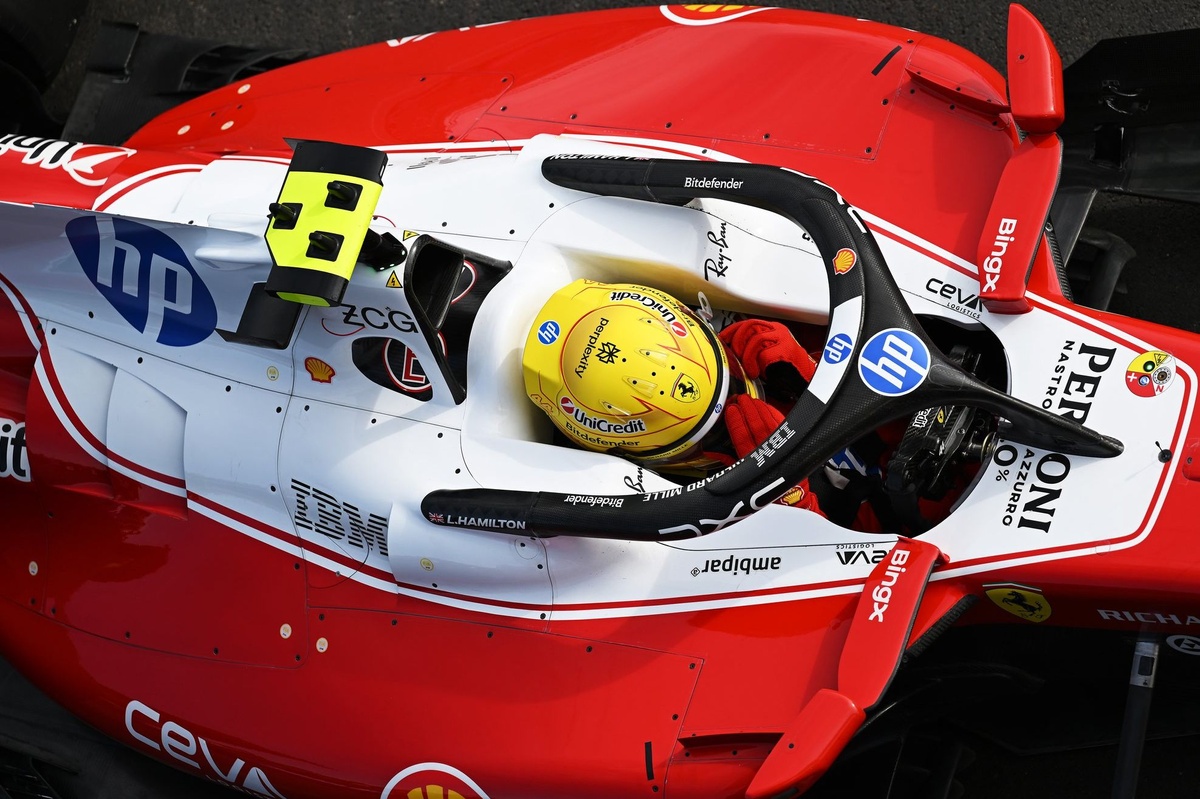
Lewis Hamilton's Grand Prix was a particularly grim catalogue of setbacks. Starting with a grid penalty, his race was then marred by a series of misfortunes. He was notably overtaken by Max Verstappen on track. A late virtual safety car pit stop was a calculated risk that failed to pay off, as he couldn't subsequently pass Kimi Antonelli.
To compound the misery, Hamilton incurred a five-second penalty for speeding in the pitlane, a clear indicator of the team's frantic, yet ultimately self-defeating, push to regain lost time. Vasseur summarized it as a "succession of mistakes," each one building on the last.
Underlying Pace Couldn't Salvage Execution
Despite the catastrophic Sunday, Vasseur maintained that the car's inherent speed was competitive, perhaps even better than previous outings in Spa or Silverstone. "The pure pace of the team was probably better this weekend," he noted, underscoring the frustration that their performance deficit wasn't a matter of raw speed but of flawless execution.
This sentiment highlights a recurring theme for Ferrari: the capability is there, but the ability to consistently deliver a clean, error-free race weekend remains elusive. For the Scuderia, the Hungarian Grand Prix serves as a stark reminder that in Formula 1, potential alone is not enough; flawless execution is paramount. "Point taken for the rest of the season," a determined Vasseur concluded, signalling a clear directive for improvement.