

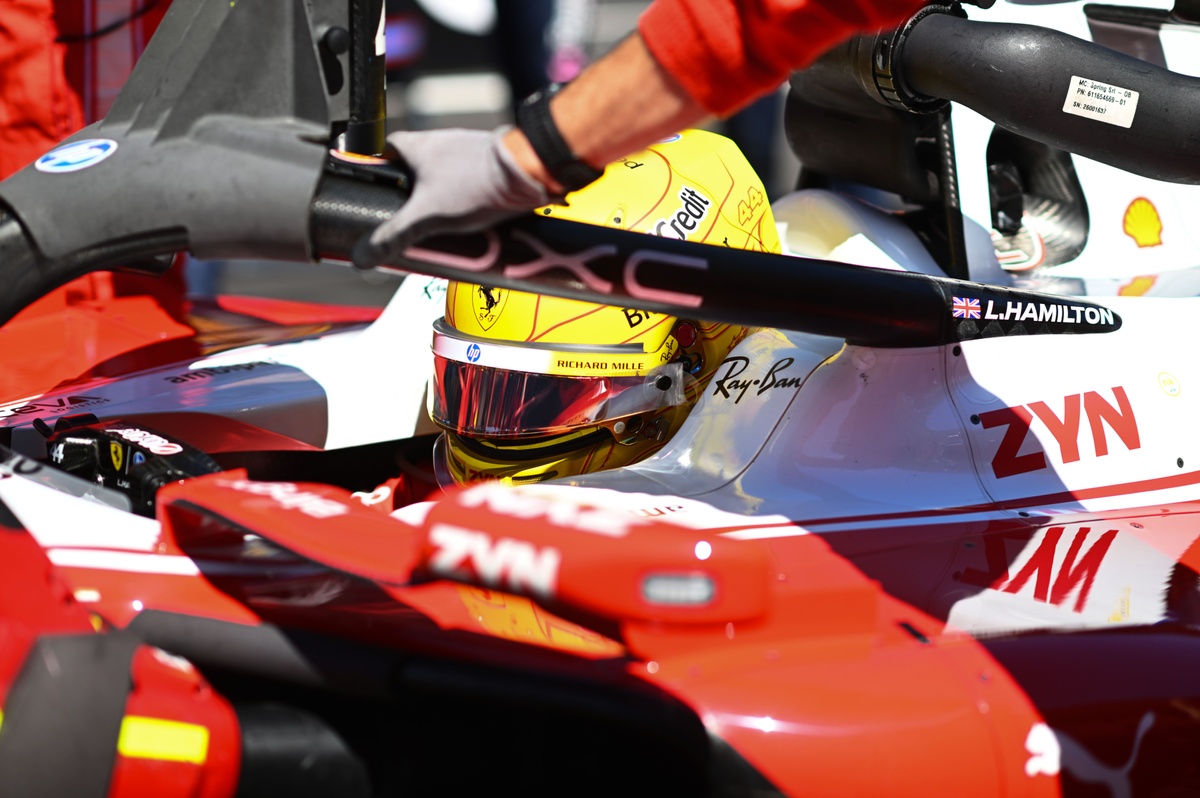

Barely into the Spanish GP, Lewis Hamilton saw his promising start unravel after a sudden brake problem while battling Max Verstappen for third. The Ferrari driver's brake pedal began going long during the opening laps, leaving him struggling to slow the car properly.
Key Highlights:
- Lewis Hamilton suffered a sudden brake failure while battling Max Verstappen for third during the opening laps.
- The Ferrari driver continued to miss braking points after initial attempts to resolve the issue from the pit wall, including a brush with the wall.
- Ferrari called Hamilton into the pits to retire the car, with Fred Vasseur saying there was no reason to take further risks.
- Vasseur believed Ferrari had the pace to fight at the front but admitted track position made overtaking extremely difficult during the 57-lap race.
Hamilton's Brake Failure Brings Early End in Madrid
Hamilton initially believed the issue might be manageable after Ferrari engineers instructed him to change several settings. However, the problem returned just a few corners later, with the Briton continuing to miss braking points and even brushing the wall.
"It was really unexpected," Hamilton said, explaining that the car had initially stopped normally when he braked for Turn 5. The pedal then took a step, causing him to carry too much speed into the corner before briefly returning to normal.
The problem soon became more severe, with the pedal eventually going "fully to the end." Hamilton admitted he was "lucky to make it round" as he managed to return to the garage.
Ferrari Chooses Safety Over Risk
With the Madring's 5.4km circuit lined by walls, Ferrari quickly decided that continuing with compromised brakes was not worth the risk. Hamilton was called into the pits and retired from the race after the team failed to resolve the problem remotely.
Team Principal Fred Vasseur explained that Ferrari had attempted to fix the issue from the pit wall, but the problem returned shortly afterwards. "Staying on track made no sense in a crazy race. We didn't want to take any risk," Vasseur said.
The decision ended Hamilton's race early, but Ferrari's concerns were understandable given the severity of the brake problem and the unforgiving nature of a wall-lined circuit.
Ferrari Had Pace But Track Position Ruled
Despite Hamilton's retirement, Vasseur felt Ferrari had shown enough pace to compete near the front. He pointed to the performance of Charles Leclerc as evidence that the team could have challenged its rivals.
However, Vasseur also acknowledged that the 57-lap Spanish GP offered few opportunities to change positions. With overtaking proving extremely difficult, track position became the dominant factor in determining the outcome.
"When you see the pace of Charles, you can imagine that we had the pace to fight with everybody," Vasseur said. "It's more a matter of track position."
For Hamilton, that meant a frustrating end to what had initially looked like a promising race. The sudden brake failure left Ferrari with little choice but to bring him in, ensuring the issue did not develop into a more serious incident.


