
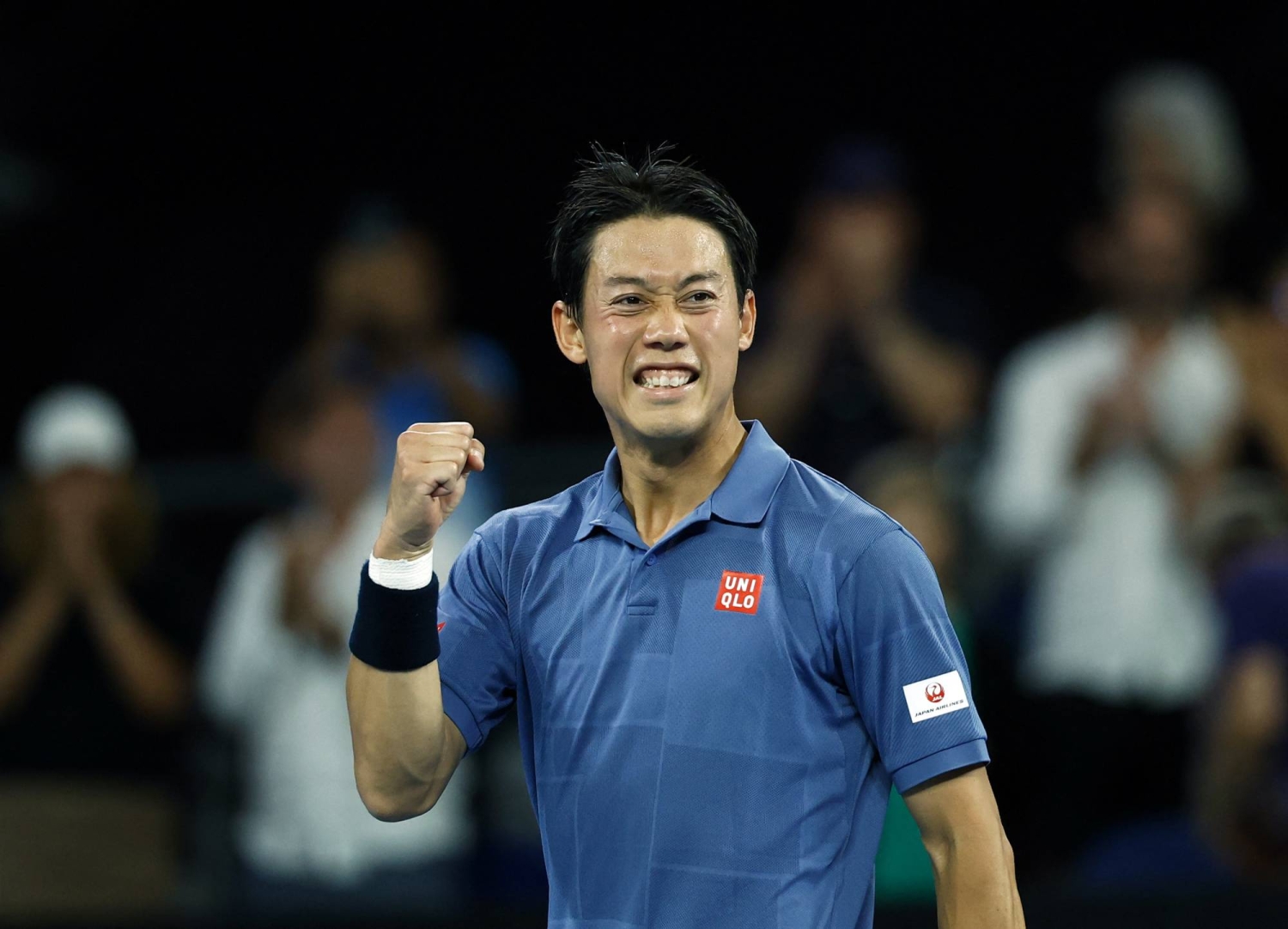

Kei Nishikori has retired from professional tennis after a remarkable career that reshaped Japanese tennis and opened new possibilities for players across Asia.
For almost two decades, Nishikori competed at the highest level of the sport, overcoming a lack of physical power with exceptional timing, anticipation and an ability to raise his level when matches reached their most demanding stages.
His career reached its defining moment at the 2014 US Open, when he became the first Asian man to reach a Grand Slam singles final. But the achievement was just one part of a career that also included 12 ATP Tour titles, an Olympic bronze medal and victories over all three members of tennis' Big Three.
Nishikori was born in Shimane and moved to Florida at the age of 14 to develop his game at IMG Academy. Despite facing a language barrier and adapting to life far from home, he turned professional in 2007 and steadily established himself on the ATP Tour.
He went on to win 12 ATP titles and reached another 15 finals, including four at Masters 1000 level. He also qualified for the ATP Finals four times, reaching the semi-finals on two occasions.
One statistic perhaps captures Nishikori's competitive character better than any other. He won 158 of the 218 deciding sets he played, giving him a 72.5% success rate. Only Bjorn Borg and John McEnroe have posted better records in deciding sets among the players ahead of him on the list.
His record in five-set matches was equally impressive, with Nishikori winning 78.4% of them.
That ability to survive long, demanding matches was on full display during his extraordinary 2014 US Open campaign.
Nishikori defeated Milos Raonic in a five-set fourth-round battle before producing another five-set victory over Stan Wawrinka in the quarter-finals. After spending more than eight hours on court across those two matches, he faced world No. 1 Novak Djokovic in the semi-finals.
Despite the physical demands, Nishikori produced one of the biggest victories of his career, defeating Djokovic in four sets to reach his first Grand Slam final.
He ultimately lost to Marin Cilic, but the run made history. Nishikori became the first Asian man to reach a Grand Slam singles final and gave Japanese tennis a landmark achievement on the biggest stage.
His success was not limited to Grand Slam tennis.
Nishikori collected seven wins against the Big Three during his career, beating Roger Federer three times, Rafael Nadal twice and Djokovic twice.
One of his most memorable victories came at the 2016 Rio Olympics, where he defeated Nadal in a three-set bronze-medal match. The result gave Japan its first Olympic tennis medal in almost a century.
Five years later, Nishikori reached the quarter-finals of the Tokyo Olympics, where he defeated fifth seed Andrey Rublev before his run ended in the last eight.

Source: The Strait Times
Even as injuries increasingly disrupted the latter stages of his career, Nishikori continued to compete. In 2025, at the age of 35 and six years after his previous ATP Tour title, he reached the final in Hong Kong and defeated Karen Khachanov along the way.
He also continued competing on the ATP Challenger Tour, showing that his motivation remained strong despite the physical challenges.
That determination has made Nishikori an important figure for the next generation of Japanese players.
Rei Sakamoto is among those who grew up watching him, openly describing Nishikori as his idol. His influence can be seen in the growing ambitions of Japanese players who followed his path onto the international stage.
Nishikori's career ultimately became about more than titles and rankings. He demonstrated that a Japanese player could challenge the world's best and compete deep into the biggest tournaments.
In announcing his retirement, Nishikori reflected on the motivation that repeatedly brought him back to the court despite the setbacks.
“My love for tennis and my belief that I could become a stronger player always brought me back to the court,” he said. “I can proudly say that I gave it my all.”
After nearly two decades at the highest level, Nishikori leaves the sport with a legacy built on resilience, historic breakthroughs and a standard that the next generation of Japanese tennis players can aspire to follow.