
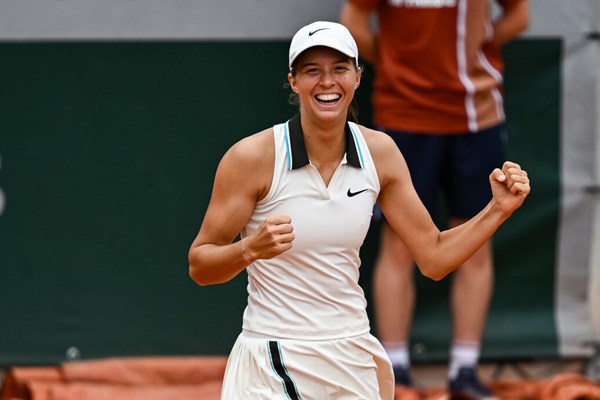

A new name has broken into the WTA Top 100, and it comes with both results and style that stand out in modern women’s tennis.
Eighteen-year-old Austrian Lilli Tagger has climbed into the elite group after a strong run of performances across both junior and professional levels, marking a major milestone in a rapidly developing career. She is also the first player born in 2008 to reach the Top 100 on either the WTA or ATP Tour.
Tagger’s rise has been shaped not only by results but also by her rare playing style. She is one of the few players on tour who uses a one-handed backhand, a shot that has become increasingly uncommon in the modern game. That technique places her among a small group of players still carrying the classic style into the highest level of competition.
Her development has been closely guided by former French Open champion Francesca Schiavone, who also built her career around a one-handed backhand. The partnership has been seen as both technical and symbolic, blending modern training with a traditional skill set that is increasingly rare in today’s game.
Tagger first gained major attention last year when she captured the junior Roland Garros title without dropping a set. Her run included victories over multiple seeded players, underlining her dominance at junior level and hinting at her potential transition into the professional circuit.
That transition has come quickly. She reached her first WTA final at a WTA 250 event in Jiujiang as a wildcard ranked outside the top 200, finishing runner-up to Anna Blinkova. More recently, she made her first WTA 500 quarterfinal in Linz, where a win over world No. 21 Liudmila Samsonova helped push her further up the rankings.
She now joins a small group of players in the Top 100 who use a one-handed backhand, alongside Tatjana Maria, Viktorija Golubic, and Diane Parry, adding further uniqueness to her rise.
Tagger continues her season this week at the WTA 250 event in Rouen, where she will face Ukraine’s Oleksandra Oliynykova in her opening match. As her profile continues to grow, she represents both a new wave of talent and a rare link to a classic style of tennis that is becoming increasingly uncommon on tour.