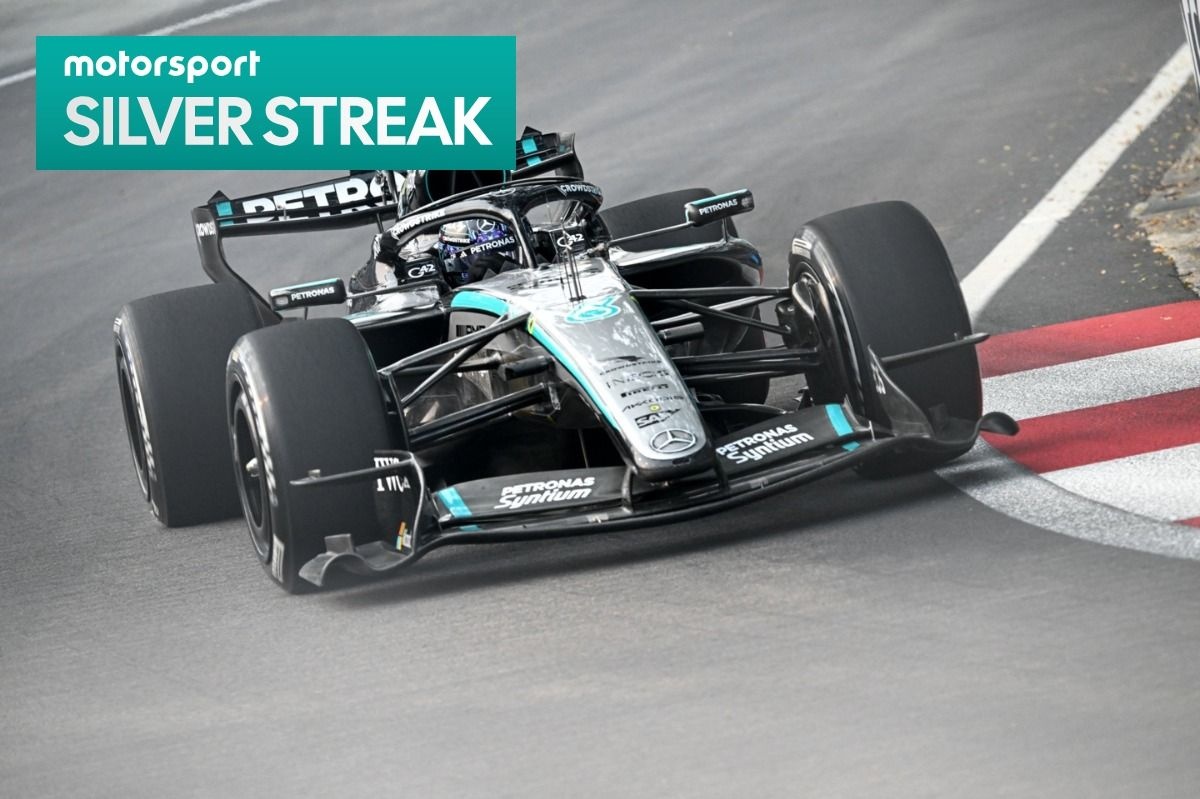



George Russell's Singapore Grand Prix was a masterclass in mitigation, but even a heroic climb from 19th to 9th couldn't mask the fundamental challenges Mercedes faced on the unforgiving Marina Bay street circuit. While the jump in positions was impressive, team boss Toto Wolff has clarified why Mercedes' pre-race aspirations fell short of reality, pointing squarely at the track's unique difficulties.
Key Takeaways from Singapore:
- George Russell executed an incredible recovery drive, moving up 10 places from P19 to P9.
- Toto Wolff attributed the inability to climb higher to the severe "dirty air" effect at Marina Bay, making overtaking nearly impossible.
- Mercedes had internally projected a P7 finish as the best-case scenario for Russell.
- Russell also faced unfortunate timing with a Virtual Safety Car (VSC) that could have offered a strategic advantage but ended just as he entered the pits.
The Gauntlet of Marina Bay: Why Overtaking Was a Nightmare
Marina Bay is renowned for its tight corners and punishing street circuit layout, and for Mercedes, it became a lesson in aerodynamic frustration. Toto Wolff explicitly stated that the moment a car closes on another, the "dirty air" becomes a massive hindrance, robbing the following car of crucial downforce. This phenomenon transformed George Russell's otherwise rapid pace into a deadlock.
Russell, despite being potentially 1.5 seconds faster than the cars ahead, found himself unable to make passes. This isn't just a challenge; it's a fundamental characteristic of modern F1 cars on certain circuits, turning raw speed into a mere academic advantage when trapped in traffic.
Wolff's Candid Assessment: "Damage Limitation"
For Mercedes, the Singapore GP was always going to be a tough weekend after Russell's grid penalty. Wolff's appraisal of the P9 finish was pragmatic: "a damage limitation race." While a P7 finish was the internal best-case scenario, the realities of Marina Bay and the relentless dirty air proved insurmountable.
Wolff even quipped about the "good TV coverage" Russell's battle through the field provided, a nod to the spectacle while acknowledging the team's underlying performance struggle. It highlights the fine line between a visually exciting drive and a truly optimal race result.
Russell's Rollercoaster: Bad Luck Strikes Again
Beyond the track's inherent difficulties, George Russell also encountered a dose of bad luck. A perfectly timed Virtual Safety Car (VSC) could have given him a cheap pitstop and a strategic boost. However, the VSC period ended precisely as he was approaching the pit entry, nullifying any potential gain.
Russell, ever the pragmatist, refused to dwell on it, stating he wouldn't "lose any sleep over that." His focus remains squarely on Mercedes' broader challenge: understanding how to extract more performance, especially after witnessing the dominant pace of rivals like Red Bull across varied circuits.
From the Back of the Grid: The Pre-Race Handicap
Russell's uphill battle began long before the lights went out in Singapore. A significant 60-place grid penalty was levied against him due to a power unit failure at the Bahrain Grand Prix. The replacement of multiple power-unit components, including the Energy Store and Control Electronics Unit, meant he started from an unenviable 19th position.
This massive penalty instantly placed Mercedes on the back foot, transforming their weekend into an exercise in recovery rather than contention. Despite this immense handicap, Russell's drive from P19 to P9 underscores his talent, even as it exposes the limitations of the car and circuit in certain scenarios.