

Singapore Shocker: Aston Martin's Power Unit Problem Explodes
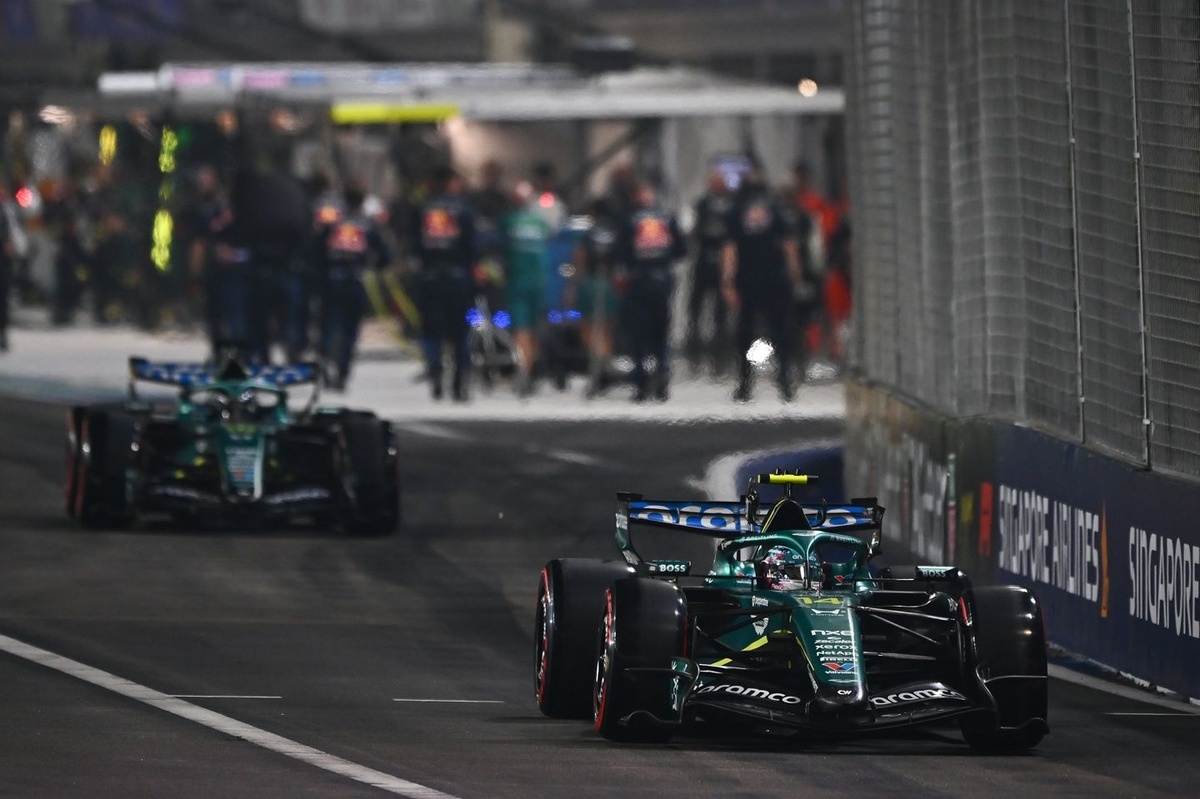
Formula 1 is a brutal sport, and Aston Martin learned that lesson the hard way at the Singapore Grand Prix, as a persistent Honda power unit flaw, turbo lag, unexpectedly resurfaced.
Key Takeaways from Singapore's Power Unit Puzzle:
- Aston Martin's performance at the Singapore GP was severely hampered by unexpected turbo lag.
- Honda's recent turbocharger upgrade, intended to eliminate this very issue, proved ineffective on the unique Marina Bay circuit.
- Limited MGU-K energy harvesting on "energy-rich" tracks like Singapore exacerbated the driveability nightmare.
- No hardware fault was found, but Honda is implementing software-based countermeasures for future races.
After a surprisingly strong showing in Malaysia, Aston Martin arrived at the Marina Bay Street Circuit with soaring expectations. On paper, the tight, twisty layout of Singapore should have played right into the AMR26's strengths. However, reality delivered a crushing blow, leaving drivers like Fernando Alonso battling severe driveability issues.
Early reports from Alonso pointed directly to problems with the Honda power unit. Subsequent in-depth investigations by Honda engineers in Sakura, Japan, confirmed the culprit: not a hardware failure, but a deeply frustrating return of turbo lag.
The Ghost of Turbo Lag Haunts Honda
Turbo lag – that dreaded delay between pressing the accelerator and feeling the turbo's full power – is a recurring nightmare for F1 teams. For Honda, this wasn't a new issue; it had previously hampered performance with a power unit specification introduced at Zandvoort.
Crucially, Honda had spent one of its precious ADUO tokens on a brand-new turbocharger in Madrid, specifically designed to eradicate this very problem. So, why did it strike back with such force in Singapore? Shintaro Orihara, Honda's Chief Trackside Engineer, provided clarity.
"Even though we introduced a new turbocharger to manage turbo lag, we still struggled to manage that lag in Singapore because of the unique track layout and also the energy-rich situation," Orihara revealed. This unique combination created "unstable acceleration" for the drivers, a critical disadvantage on a street circuit.
MGU-K: A Double-Edged Sword?
The complexity deepens when considering the MGU-K, the kinetic motor-generator unit. While MGU-K deployment can partially mitigate turbo lag, it's far from a complete solution. Orihara explained a key aspect of their Singapore struggles: energy harvesting.
"If we go to energy-rich tracks, we normally use the MGU-K harvesting to compensate for turbo lag," he stated. However, in Singapore's high-energy environment, it proved difficult to generate sufficient MGU-K harvesting power. This meant the engine couldn't maintain the high operating point needed to keep turbo lag in check.
Honda's Software Solution & Aston Martin's Hard Truth
The fact that Honda's extensive checks at Sakura found no specific hardware fault is both a relief and a concern. It means the core power unit components are sound, but the underlying operational challenge persists. This raises the alarming possibility of similar issues arising at other "energy-rich" circuits.
However, Honda is not standing still. The team has learned vital lessons, leading to new measures. These aren't hardware changes but rather sophisticated software adjustments and operational settings for the power unit. Orihara confirmed: "We understand that we need to improve our control of the turbo lag."
Learning from Disappointment: Krack's Candid Admission
For Aston Martin Chief Trackside Officer Mike Krack, the disappointment in Singapore was amplified by inflated expectations. "I always call them the emotional dynamics," Krack reflected. "Sepang probably surprised us in terms of outcome and it raised the expectation level [for Singapore] maybe even beyond what was realistic."
This gap between hope and reality made the weekend's struggles even tougher to stomach. Krack also highlighted the limitations of simulations. "It is something that in simulations you cannot really have this clear picture," he explained, referring to the nuanced impact of turbo lag and MGU-K issues on driveability.
Charting a Course Forward for Aston Martin
Beyond the technical fixes, Krack stressed the mental lessons learned. The team is now focused on regrouping, thoroughly understanding their performance deficits, and critically, managing expectations more effectively. "It’s also important to manage our expectations a little bit better, or at least when you manage expectations, that you have a set of risks that could affect it, which we didn't do in Singapore," he concluded.
The road ahead for Aston Martin and Honda involves meticulous fine-tuning and a clear-eyed assessment of track characteristics. The goal: ensure the ghost of turbo lag stays buried, especially as the F1 season progresses to circuits where power unit nuances are key.