

Across their three meetings with the San Antonio Spurs this season, including the NBA Cup final, the New York Knicks produced an impressive offensive rating of 125.0 points per 100 possessions. That figure stands out considering San Antonio finished the regular season as the league’s third-ranked defensive team, allowing just 110.4 points per 100 possessions.
Key Highlights
- Knicks posted an elite 125.0 offensive rating across three meetings with the Spurs.
- Offensive rebounds and second-chance points were the biggest factors behind New York’s success.
- San Antonio’s defensive strategy leaves them vulnerable to size mismatches involving Karl-Anthony Towns.
- Mitchell Robinson’s availability could be crucial, given his major impact on the offensive glass.
Knicks Found Success Through Extra Possessions Against Spurs
Only the Denver Nuggets were more efficient offensively against the Spurs during the regular season. Interestingly, New York’s best shooting performance came in a narrow two-point defeat in San Antonio on December 31, while their two victories featured shooting numbers that were actually slightly below league average. Despite that, the Knicks continued to score efficiently thanks to their dominance in key possession battles.
Second-Chance Opportunities Made the Difference
New York repeatedly punished the Spurs through offensive rebounding and ball security.
During the NBA Cup final, the Knicks turned 23 offensive rebounds into 32 second-chance points. Their March 1 victory brought a similar story, with 18 offensive boards generating 23 second-chance points. Across all three matchups, New York also protected possession well, committing only 35 total turnovers, equivalent to 11.8 per 100 possessions.
The Spurs are not known for forcing mistakes. While their guards apply pressure, their defensive schemes tend to be more conservative. They ranked 28th in opponent turnover rate during the regular season and have remained near the bottom of the league in that category throughout the playoffs.
However, San Antonio’s greatest regular-season strength was defensive rebounding, where they ranked No. 1 in the NBA. That made their struggles on the glass against New York particularly surprising and is expected to become a major focus heading into Game 1 of the Finals.
Offensive Rebounding Defines New York's Identity
The Knicks have been one of the most aggressive teams on the offensive glass throughout the postseason, ranking third among playoff teams.
A major reason is Mitchell Robinson, who has collected an exceptional 18.3% of available offensive rebounds while on the court — the highest rate among playoff players averaging at least 10 minutes per game. Karl-Anthony Towns has also played a significant role, ranking among the league leaders in offensive rebounding percentage.
Beyond the frontcourt, contributions have come from across the roster. Reserve guard Jordan Clarkson has collected 16 offensive rebounds in limited minutes, while Josh Hart continues to thrive through relentless hustle. Wings OG Anunoby and Mikal Bridges also made valuable contributions against San Antonio during the regular season series.
“That’s just our identity,” Clarkson said of his team’s offensive rebounding prowess and his role in creating second chances. “One through 15, I think we’re all trying to impact the game in any way.”
Spurs Face Difficult Matchup Problems
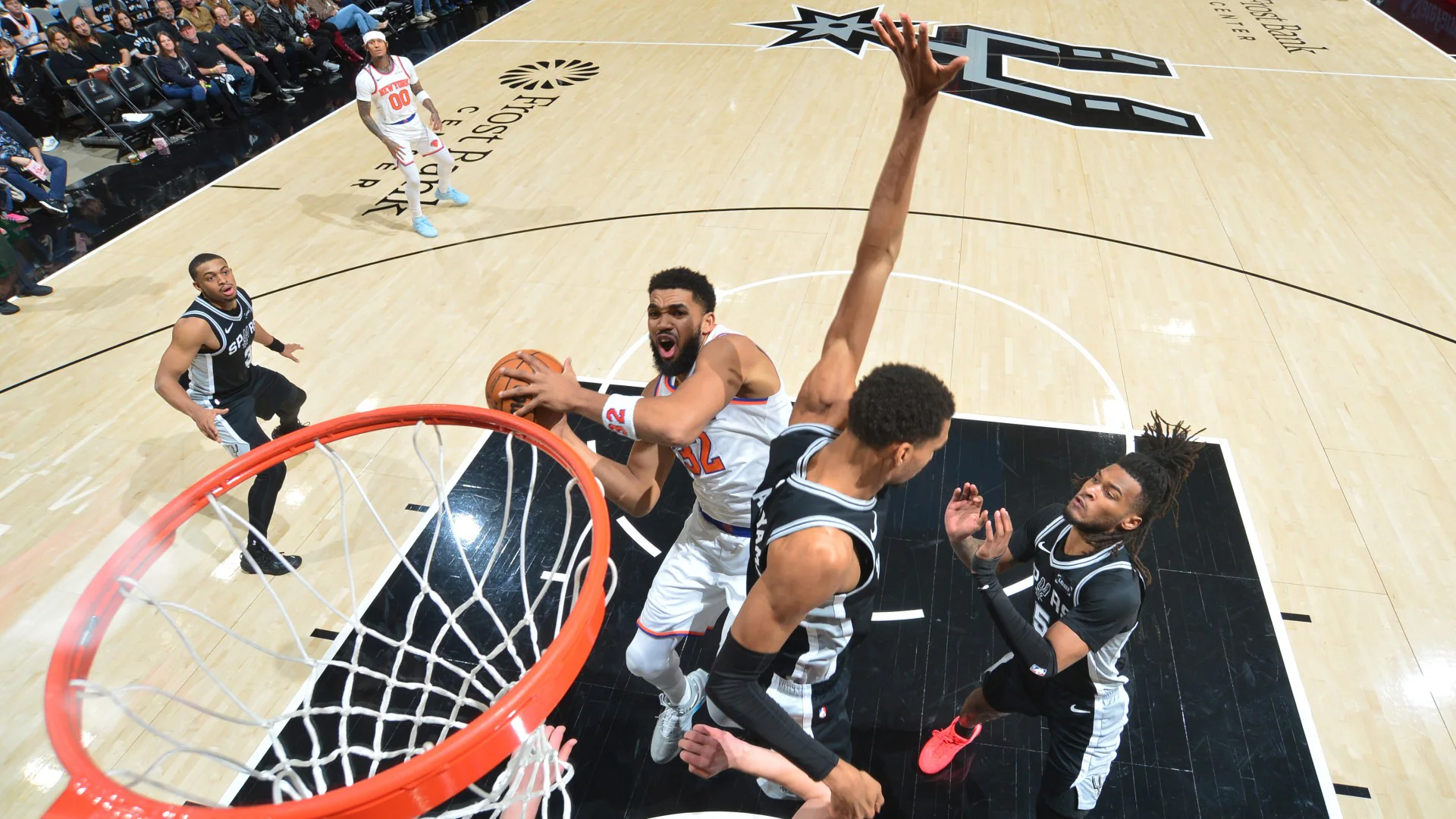
One reason the Knicks dominated the offensive glass was the way the Spurs chose to defend Karl-Anthony Towns.
In the March meeting, Towns frequently found himself guarded by smaller players such as Stephon Castle and Devin Vassell. That alignment allowed Victor Wembanyama to stay closer to the paint and act as a roaming rim protector, while also giving San Antonio flexibility when switching screens.
The downside was evident around the basket, where Towns was often able to exploit size advantages. While keeping Wembanyama near the rim remains a defensive priority, San Antonio lacks an ideal physical matchup for Towns, creating potential problems both in the post and on the boards.
Robinson Creates a Different Challenge
When Mitchell Robinson enters the game, the matchup dynamics change again. The Spurs often assign Wembanyama directly to Robinson, helping solve some of the size mismatches that occur when Towns is on the floor. However, that adjustment does little to reduce New York’s rebounding threat.
Robinson is heavily involved in pick-and-roll actions with Jalen Brunson, setting nearly twice as many screens as Towns. Unlike Towns, Robinson consistently rolls toward the basket after setting screens, creating opportunities for lob finishes and offensive rebounds. His ability to establish inside position can also neutralize some of Wembanyama’s length advantage, turning rebounds into physical battles where strength becomes just as important as reach.
There is one concern for New York, however. Robinson is currently listed as questionable for Game 1 after suffering a fractured finger following the Eastern Conference Finals. Should he be unavailable, the Knicks would lose one of their most effective weapons on the offensive glass — an area that has been central to their success against San Antonio all season.