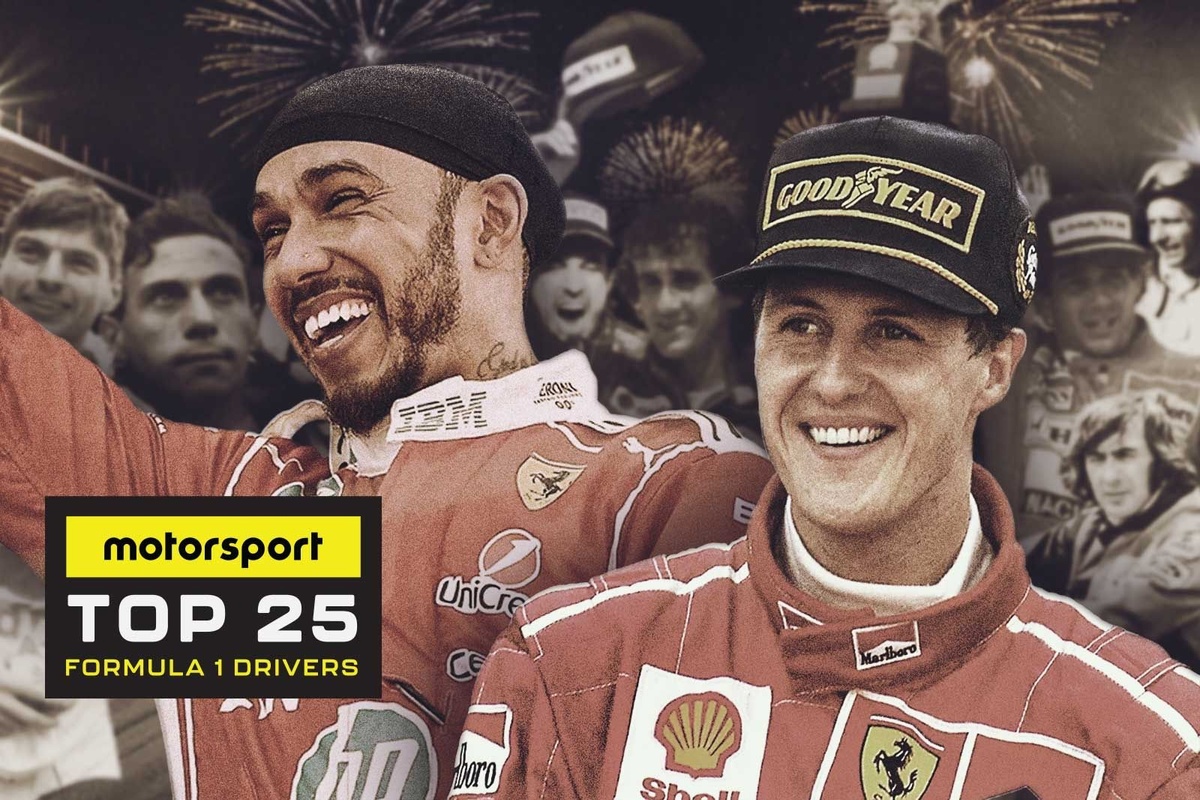

Who is the greatest Formula 1 driver of all time? A panel of 10 motorsport journalists has attempted to settle one of racing's most enduring debates—and somehow, the result couldn't be closer. Lewis Hamilton and Michael Schumacher have finished level at the very top, with both legends scoring exactly 235 points in a ranking of the 25 greatest F1 drivers.
Comparing drivers from completely different eras is never straightforward. Cars have evolved, safety standards have transformed, and championship calendars have changed dramatically. Yet, that hasn't stopped fans and experts from asking the same question for generations: who truly deserves the crown?
This ranking offers 25 answers, spanning some of the most iconic names in F1 history before culminating in an extraordinary dead heat between two seven-time world champions.
Key Takeaways:
- Lewis Hamilton and Michael Schumacher shared first place with 235 points each.
- Hamilton received four first-place votes, compared with two for Schumacher, but the overall ballot scoring produced a tie.
- Juan Manuel Fangio, Ayrton Senna, Alain Prost, and Max Verstappen were among the other legends to feature prominently near the top.
- The ranking stretches across generations, from early pioneers such as Alberto Ascari and Stirling Moss to modern icons including Hamilton and Verstappen.
Button's Legacy Goes Far Beyond His 2009 Miracle
Jenson Button is often defined by his remarkable 2009 Brawn GP championship, but his career was about far more than one extraordinary season. His longevity and consistency established him as one of F1's enduring talents.
Button competed across 18 F1 seasons and made 309 Grand Prix starts, collecting 15 victories along the way. Those numbers underline that his championship triumph was not simply a one-season fluke, but the culmination of a long and distinguished career.
John Surtees: The Champion Who Conquered Two Worlds
Long before John Surtees became an F1 world champion, he had already established himself as a giant of motorcycle racing. His move from two wheels to four produced one of motorsport's most remarkable careers.
Driving for Ferrari, Surtees captured the 1964 world championship and recorded six Grand Prix victories. His speed was evident almost immediately: he finished second in only his second F1 start before taking pole position in his third. His achievements made him a genuine master across two disciplines.
Gilles Villeneuve: A Legend Built on Fearless Driving
Few drivers captured the spirit of Formula 1 quite like Gilles Villeneuve. His statistics alone—just six Grand Prix victories—don't fully explain the place he occupies in F1 folklore.
Villeneuve's aggressive, fearless style and immense popularity turned him into a Ferrari icon whose influence far exceeded his numbers. His death at Zolder in 1982, aged just 32, only deepened the lasting impact of a driver remembered as much for his passion as his results.
Jochen Rindt: The Champion Who Made History After Death
Jochen Rindt had a relatively short F1 career, but his achievements were extraordinary. He recorded 60 world championship starts, six Grand Prix victories, and 10 pole positions as his raw speed developed into genuine championship-winning form.
His death during practice at Monza in 1970 meant he became—and remains—Formula 1's only posthumous world champion. His title was secured because of the commanding advantage he had built during that season, leaving behind one of the most tragic and unique chapters in F1 history.
Mario Andretti: America's F1 Dream Realized
Mario Andretti brought an extraordinary range of motorsport experience to Formula 1, but his achievements with Lotus remain central to his legacy.
Andretti played a key role in turning Lotus into a winning force, while his mastery of the revolutionary ground-effect Lotus 79 helped him capture the 1978 Formula 1 world championship. That success cemented his status as an international racing icon.
Kimi Raikkonen: The Iceman's Ferrari Masterstroke
At his peak, Kimi Raikkonen was one of F1's most formidable competitors. After narrowly missing out on championships during his McLaren years, the Finn finally reached the summit by delivering the 2007 Drivers' Title to Ferrari.
Raikkonen tied Mario Andretti on points in the ranking, but his appearance on all 10 ballots demonstrated the lasting impression he made throughout the 2000s. Editor Oleg Karpov ultimately cast the tie-breaking vote in Raikkonen's favor.
Nelson Piquet: Three Championships in a Golden Era
The 1980s produced some of Formula 1's fiercest competition, and Nelson Piquet emerged as one of its defining figures. Across seven seasons, he captured three world championships and recorded 23 victories.
His first two titles came with Brabham in 1981 and 1983. His third arrived in 1987 with Williams, following a fierce championship battle against teammate Nigel Mansell.
Emerson Fittipaldi: From Rookie Sensation to McLaren History
Emerson Fittipaldi wasted little time announcing himself in Formula 1. The Brazilian won his first Grand Prix during his rookie season before rapidly establishing himself among the sport's elite.
He claimed championships with Lotus in 1972 and McLaren in 1974, becoming the latter team's first-ever Formula 1 world champion. Across 144 starts, Fittipaldi accumulated 14 Grand Prix victories, reflecting both the speed of his rise and the longevity of his impact.
Mika Hakkinen: The Finn Who Finally Stopped Schumacher
Mika Hakkinen's career could easily have ended in tragedy after a career-threatening crash in 1995. Instead, he returned to the track and went on to become the driver who finally interrupted Michael Schumacher's early dominance.
Driving for McLaren, Hakkinen secured consecutive world championships in 1998 and 1999. He ultimately retired with 20 Grand Prix victories and 26 pole positions, earning a lasting reputation as Schumacher's defining rival of the late 1990s.
Nigel Mansell: The Lion's 1992 Masterclass
Nigel Mansell may have won only one world championship, but his career was defined by years of fighting at the front of an intensely competitive F1 grid.
After several near misses, 'The Lion' finally captured the 1992 championship with Williams in dominant fashion. He ended his career with 31 victories, 32 poles, and 59 podiums, numbers that tell the story of a driver who spent much of his career battling at the sharp end.
Jack Brabham: The Champion Who Won in His Own Car
Few achievements in Formula 1 can match what Jack Brabham accomplished in 1966. He became the only driver in F1 history to win the world championship in a car carrying his own name.
Already a two-time champion with Cooper in 1959 and 1960, Brabham's third title combined his abilities as a driver, team owner, and technical force. It remains one of the sport's most remarkable demonstrations of talent both behind the wheel and away from it.
Graham Hill: Two Championships Six Years Apart
Graham Hill built a career defined by versatility, consistency, and longevity. His first world championship arrived with BRM in 1962, before he returned to the top with Lotus in 1968.
Hill recorded 14 Grand Prix victories, with his 1962 campaign particularly notable for its consistency and reliability against his rivals.
Stirling Moss: F1's Greatest Uncrowned Champion
Stirling Moss occupies a unique place in Formula 1 history as arguably the greatest driver never to win the world championship.
He collected 16 Grand Prix victories and finished runner-up for four consecutive seasons from 1955 to 1958. Much of his legend came from his ability to extract extraordinary performances from machinery that was often inferior to that of his rivals. His sublime car control and natural talent remain central to his enduring reputation.
Alberto Ascari: Ferrari's Early Dominant Force
During F1's formative years, Alberto Ascari emerged as the driver most capable of challenging Juan Manuel Fangio. His numbers were remarkable: 13 wins and 14 poles from just 32 starts.
Ascari won back-to-back Ferrari championships in 1952 and 1953, with his 1952 campaign featuring an extraordinary run of six consecutive championship Grand Prix victories.
Sebastian Vettel: Red Bull's Four-Year Reign
The early 2010s belonged to Sebastian Vettel. Driving for Red Bull, he captured four consecutive championships from 2010 to 2013, establishing one of the sport's defining modern dynasties.
Vettel finished his career with 53 Grand Prix victories, 57 poles, and 122 podiums from 299 starts. His 2013 season stood out as the peak of his dominance and helped cement his place among F1's elite.
Fernando Alonso: The Art of Extracting More
Fernando Alonso's two world championships only tell part of his story. His reputation was built on an extraordinary ability to extract maximum performance from whatever machinery he had underneath him.
The clearest example came in 2012, when Alonso took his Ferrari—which was, on average, only the fourth-fastest car—into a championship battle that lasted until the final race. He ultimately finished behind Vettel by just three points, a result that perfectly captured his talent and tenacity.
Jim Clark: F1's Pure-Speed Master
Jim Clark remains one of the clearest examples of raw speed combined with overwhelming dominance. The two-time world champion accumulated 25 Grand Prix victories, including an extraordinary seven wins from 10 races during his 1963 Lotus campaign.
Clark repeatedly demonstrated his superiority against highly capable teammates in equal machinery. His tragic death in 1968 robbed Formula 1 of one of its most exceptional talents.
Niki Lauda: The Ultimate Comeback
Few F1 careers embody resilience like that of Niki Lauda. His combination of speed, intelligence, and determination produced three world championships across two different teams and eras.
Lauda won titles with Ferrari in 1975 and 1977 before returning from retirement with McLaren to claim his third championship in 1984. He famously beat teammate Alain Prost by just half a point. Although Lauda received no first-place votes in this ranking, his consistently high positions reflected the universal respect he commands.
Sir Jackie Stewart: Champion and Safety Pioneer
Sir Jackie Stewart dominated during a nine-season career that produced three world championships and 27 Grand Prix victories.
His partnership with Ken Tyrrell delivered all three titles and 25 of those victories. Stewart retired as reigning world champion at the end of 1973, but his influence extended far beyond his racing achievements. He became a pivotal figure in the campaign for vastly improved driver safety.
Max Verstappen: A Modern Dynasty Still Rewriting History
Max Verstappen has already established himself among Formula 1's all-time greats, and his record continues to grow. He captured four consecutive world championships from 2021 to 2024 and had amassed an astounding 71 Grand Prix victories by mid-2026.
From becoming F1's youngest-ever starter to winning on his Red Bull debut, Verstappen has repeatedly pushed the boundaries of what was considered possible. His career remains a continuing assault on the record books.
Alain Prost: Precision Over Flash
Known as 'The Professor,' Alain Prost built his legacy on precision, intelligence, and calculated racecraft. His four championships and 51 victories established a benchmark for excellence before the Schumacher era.
Prost won three titles with McLaren in 1985, 1986, and 1989, then returned to the top with Williams in 1993. Despite receiving no first-place votes from the panel, his consistent high placement demonstrates the respect voters have for his remarkable career.
Juan Manuel Fangio: The Original F1 Benchmark
Juan Manuel Fangio set the standard for greatness during Formula 1's earliest championship years. In just seven full seasons, he won five world championships, achieving the remarkable feat with four different teams.
His 24 victories from 51 starts translate into a win rate of nearly 50%, an astonishing figure by any measure. Two expert voters ranked Fangio first overall, recognizing the extraordinary dominance of a driver who helped define the sport's earliest era.
Ayrton Senna: Speed, Passion, and Immortality
Ayrton Senna combined breathtaking qualifying speed with an ability to produce unforgettable performances when the pressure was at its highest.
The Brazilian secured three world championships, 41 Grand Prix victories, and 65 pole positions from 161 starts. He finished only 12 points behind the top two in this ranking and appeared in the top five on nine of the 10 ballots, underlining the enduring power of his legacy.
Michael Schumacher: The Ferrari Architect
Michael Schumacher didn't simply dominate Formula 1—he helped redefine what sustained dominance looked like. His seven world championships, including two with Benetton and five consecutive titles with Ferrari from 2000 to 2004, placed him in a class of his own.
With 91 Grand Prix victories, Schumacher transformed Ferrari into an unstoppable force during one of the most dominant periods in F1 history. Nine of the 10 voters placed him inside their top three, helping him reach an extraordinary 235 points and a share of the top spot.
Lewis Hamilton: Seven Titles and a Historic Tie
Lewis Hamilton matched Schumacher's record of seven world championships while surpassing him to become Formula 1's all-time leader in both Grand Prix victories and pole positions.
His career includes title-winning success with McLaren and Mercedes, while 2026 brought another milestone: his first Ferrari victory. Hamilton also received more first-place votes than any other driver, earning four. Yet despite that advantage, the overall scoring left him level with Schumacher at 235 points.
The Greatest Debate Has No Single Winner
After 10 ballots and 250 individual selections, Formula 1's two seven-time world champions ended exactly where few would have expected: side by side at the summit.
Lewis Hamilton and Michael Schumacher both scored 235 points, creating a historic tie for first place. Hamilton collected four first-place votes to Schumacher's two, but the scoring across every position ultimately produced an identical total.
So, perhaps the ranking hasn't settled the GOAT debate after all. Is Hamilton your No. 1? Is it Schumacher? Or does one of the other 23 legends deserve the crown? From Fangio and Senna to Verstappen and Alonso, the arguments are endless—and that's exactly what makes the debate so compelling.