
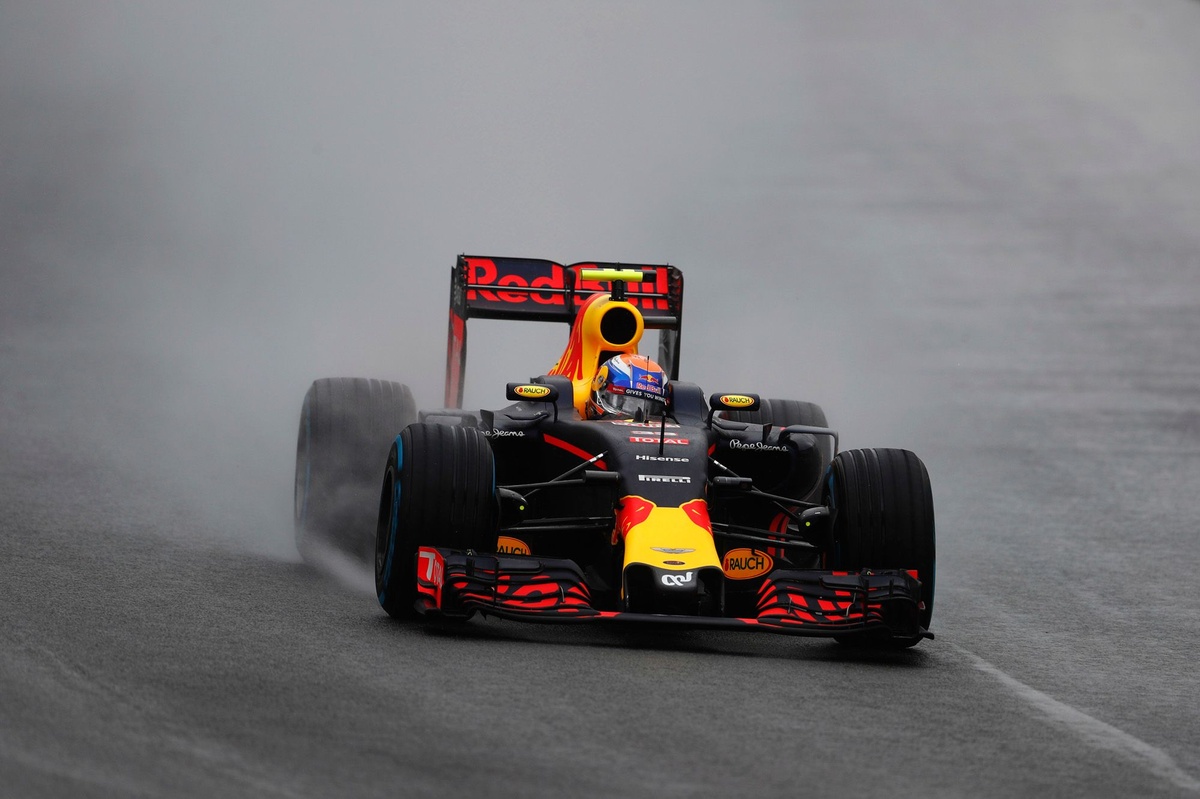

When the heavens open over Interlagos, one name consistently rises above the storm: Max Verstappen. The Red Bull driver has built a formidable reputation for his pace and precision in the chaotic, spray-filled conditions of the Brazilian Grand Prix.
Key Takeaways from Verstappen's Rain Mastery at Interlagos
- Max Verstappen boasts an impressive podium record at Interlagos, highlighting his consistent performances at the circuit.
- His ability to find grip and take alternative racing lines sets him apart in wet conditions.
- The Brazilian Grand Prix circuit's natural characteristics create overtaking opportunities, particularly in the rain, which Verstappen knows how to exploit.
- Despite his history of remarkable comebacks, Verstappen would still prefer a stronger starting position in future races.
Interlagos: Where Verstappen Unleashes the Storm
Interlagos has provided the setting for some of Verstappen's most memorable drives. With eight top-three finishes in just eleven races, it ranks among his most successful circuits since his Formula 1 debut. Many of those performances came in the heavy rain of Sao Paulo.
One standout moment came in 2016, when a teenage Verstappen charged through the field. He famously passed Kimi Räikkönen's Ferrari at Turn 1 before making an audacious move around the outside of eventual champion Nico Rosberg at Curva do Sol, further establishing his reputation in wet conditions.
Another memorable performance saw him fight through the field to claim a dominant victory despite starting deep in the pack. It highlighted his ability to read changing conditions and take advantage of even the smallest opportunities.
The Oracle of Grip: Verstappen's Wet-Weather Philosophy
How does Verstappen manage to perform so well in the rain? The four-time world champion has offered insight into his approach, pointing to a combination of natural feel and confidence behind the wheel.
Reading the Track Like No Other
"After the laps to the grid, I felt pretty confident," Verstappen explained recently. "I went out and I was like, 'Oh, low grip.' But then I actually had some cars around me and I was like, 'No, I think we actually have a lot of grip.'"
His ability to quickly assess grip levels and adjust his approach is a key part of his wet-weather strength.
"Within two laps, I was just flying by cars, almost every corner," he recalled. That quick assessment, combined with decisive driving, allows him to make rapid progress through the field.
Interlagos's Secret Weapon for Overcoming the Elements
Verstappen also believes the circuit itself plays a role in creating exciting wet-weather racing. "This track, of course, also allows you to do different lines, which I think is great because it really helps the racing," he said.
Interlagos's elevation changes and variety of possible racing lines give drivers more room to adapt, particularly in wet conditions. These characteristics can create additional overtaking opportunities for those who are comfortable exploring different lines.
"You need to feel good in the car. You need to feel comfortable to be able to risk probably a little bit more, and it's been working for me quite well here," Verstappen added.
A Champion's Desire: More Than Just Comebacks
Although his remarkable recoveries from the back of the grid have become a familiar sight, Verstappen admits that he would prefer a less complicated route to the front. His recent P2 finish after starting 21st and his 23 overtakes across three previous Brazilian Grand Prix events underline his ability to fight through the field.
Still, starting closer to the front would make life considerably easier. "Maybe next year I'd love to start a bit further up front instead of starting from the back or the pit lane, but we'll find out next year," he said.
Even with his reputation for dramatic recoveries, Verstappen remains focused on making the most of every opportunity and further strengthening his standing among Formula 1's elite.