

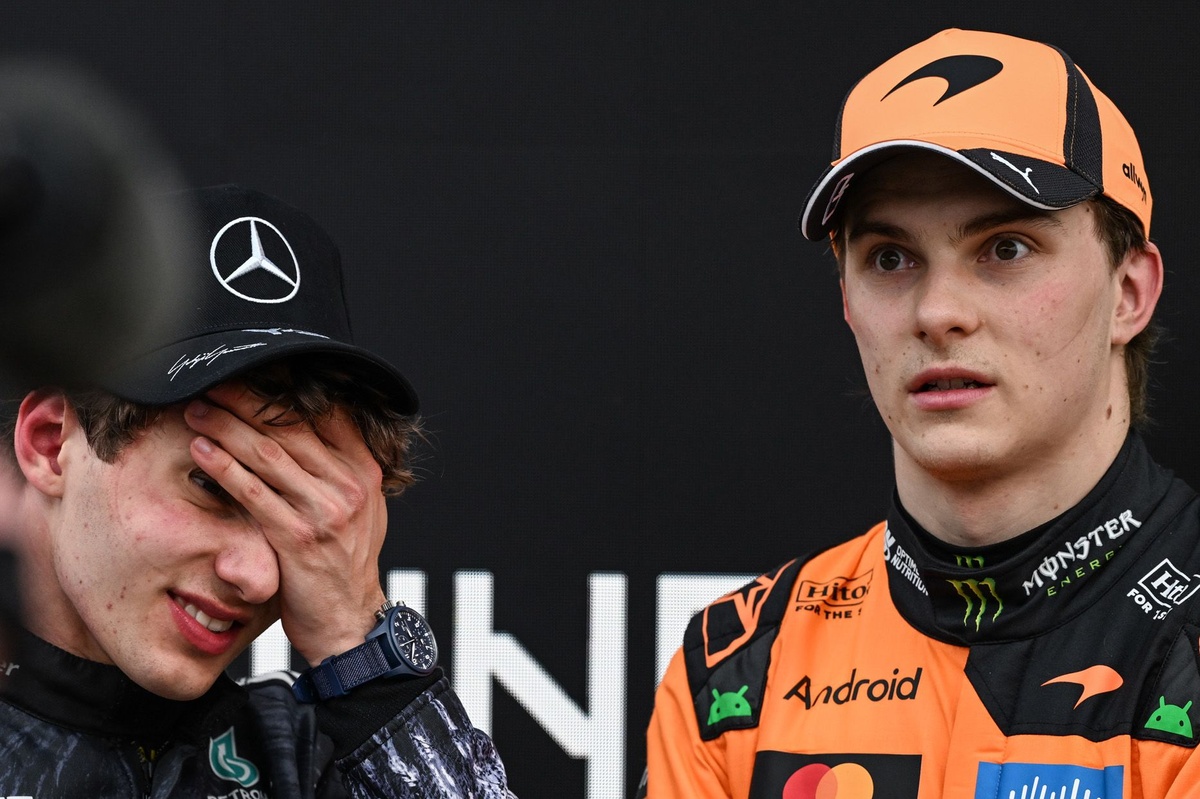

The Japanese Grand Prix delivered a brutal lesson in F1 strategy and the fickle hand of fate, leaving many to wonder if Oscar Piastri was robbed of a magnificent victory. The intervention of the safety car certainly shifted the dynamic, but a deeper dive into the data paints a fascinating picture of Mercedes' underlying dominance.
Key Points:
- Oscar Piastri of McLaren appeared poised for victory before a crucial safety car incident.
- Kimi Antonelli of Mercedes capitalized on the safety car timing for a decisive pitstop.
- Despite the race narrative, analysis confirms Antonelli's raw pace would likely have secured the win regardless.
- George Russell's challenging setup and lack of speed meant he was never a genuine contender.
Suzuka's Cruel Twist of Fate
The pivotal moment arrived on lap 22 when Haas driver Oliver Bearman's heavy crash triggered a safety car. This came at the worst possible time for McLaren's Oscar Piastri, who had just completed his mandatory pitstop. His early stop had seemingly placed him in a prime position for a projected race lead.
However, the incident proved to be a golden opportunity for Mercedes young gun Kimi Antonelli. The Italian driver, still on track, was able to make a comparatively inexpensive tyre change under the safety car conditions, effectively leapfrogging Piastri through the pitstop window. This singular event seemed to flip the script entirely.
Russell's Struggle for Speed
Before the safety car, questions arose about which Mercedes driver would have posed the biggest threat. George Russell was ahead of Antonelli on track initially, making him the leading Mercedes contender. However, the data unequivocally shows Russell lacked the outright pace to win.
Following a poor start, Russell quickly climbed back to second place but found himself unable to breach Piastri's defence. Even in clear air after Piastri's stop on lap 18, Russell only managed a modest pace increase of 0.25 seconds per lap. This simply wasn't enough to challenge for the win.
Crucially, his teammate Antonelli, once clear of traffic from Charles Leclerc and Lando Norris, demonstrated blistering speed. A direct comparison of lap times in clean air revealed Antonelli was an average of 0.61 seconds per lap faster than Russell, clocking 1m34.156s compared to Russell's 1m34.766s.
Mercedes brought Russell in on lap 21, primarily to guard against an undercut from Leclerc. Team Principal Toto Wolff later attributed Russell's struggles to a poor car setup that had also plagued him in qualifying. It's clear: Russell was never a factor in the battle for victory, regardless of the safety car.
Antonelli's Unseen Masterclass: The Overcut Threat
While the safety car undoubtedly aided Antonelli's victory, it's vital to recognize that he was the faster Mercedes driver in Japan. His true pace was initially masked by a less-than-ideal start and early skirmishes with Norris and Leclerc. Yet, once he had clear track ahead, his potential became undeniable.
Without the safety car, Mercedes would almost certainly have deployed an aggressive overcut strategy to apply immense pressure on Piastri. Post-pitstop, Piastri on fresh tyres averaged 1m34.392s, notably more than two-tenths slower than Antonelli was managing on older rubber.
Considering the typical pitstop loss at Suzuka is around 21.5 seconds, and Antonelli was already 18s ahead of McLaren before his hypothetical stop, the numbers paint a stark picture. With Antonelli's superior pace and the potential tyre delta from an overcut, a theoretical overall advantage exceeding nine-tenths per lap could have materialized.
Tyre degradation on the hard compound was approximately 0.037 seconds per lap. Over an assumed 10-lap overcut, this adds up to a theoretical 0.37 seconds per lap tyre advantage. Given Antonelli was already faster on older tyres than Piastri on fresh ones, he would have very likely rejoined the track directly behind the McLaren after a late stop.
This robust analysis suggests that a victory for Kimi Antonelli was highly probable, even without the intervention of the safety car. His raw pace and Mercedes' strategic flexibility were simply too strong.
The True Pace of the Silver Arrows
The Japanese Grand Prix data reinforces a critical point: the battle for victory appeared far closer than it genuinely was. Mercedes largely made the race exciting due to less-than-optimal starts. If the Silver Arrows can maintain their front-row positions after lap one in future races, the pecking order could become strikingly clear.
Nonetheless, there's positive news for the competition. Both McLaren and Ferrari showed improved form in Japan compared to earlier races in Australia and China. Over the entire race distance, McLaren's average gap to Mercedes was 0.29 seconds per lap, with Ferrari trailing by 0.38 seconds per lap.
Looking specifically at the more representative second stint in clean air, the gap narrowed further. McLaren (+0.53s) and Ferrari (+0.55s) were closer to Mercedes than ever before. This marks a significant improvement from Ferrari's previous 0.64s deficit in Australia and 0.58s in China, and especially McLaren's substantial 1.34 seconds per lap gap in Australia. While the gap remains, the rivals are undoubtedly closing in.


