

Knicks-Cavs Game 2: Brunson's Mastery, Shamet's Impact
The New York Knicks delivered a gut punch to the Cleveland Cavaliers in Game 1 of the Eastern Conference Finals, orchestrating a comeback that will live in franchise lore. Trailing by a massive 22 points in the fourth quarter, New York flipped the script, securing an overtime victory that feels like an early psychological blow. This isn't just one win; it's a statement, a rewrite of last year's postseason heartbreak where the shoe was on the other foot.
Key Takeaways for Game 2:
- Jalen Brunson's relentless attack on James Harden was the catalyst for the Knicks' Game 1 surge.
- The emergence of Landry Shamet as a legitimate perimeter threat significantly altered Cleveland's defensive strategy.
- Despite the loss, the Cavaliers generated quality offensive looks and must capitalize on them in Game 2.
- Cleveland faces immense pressure to make crucial defensive adjustments to contain Brunson and New York's dynamic offense.
This dramatic turnaround has set the stage for an electrifying Game 2 on Thursday. The Cavaliers, who notably battled back from a 0-2 deficit in their previous series, now face a far tougher task against a red-hot Knicks squad riding an eight-game winning streak. The intensity will be through the roof as both teams vie for control of this pivotal series.
Brunson's Masterclass: A Tactical Nightmare for Cleveland
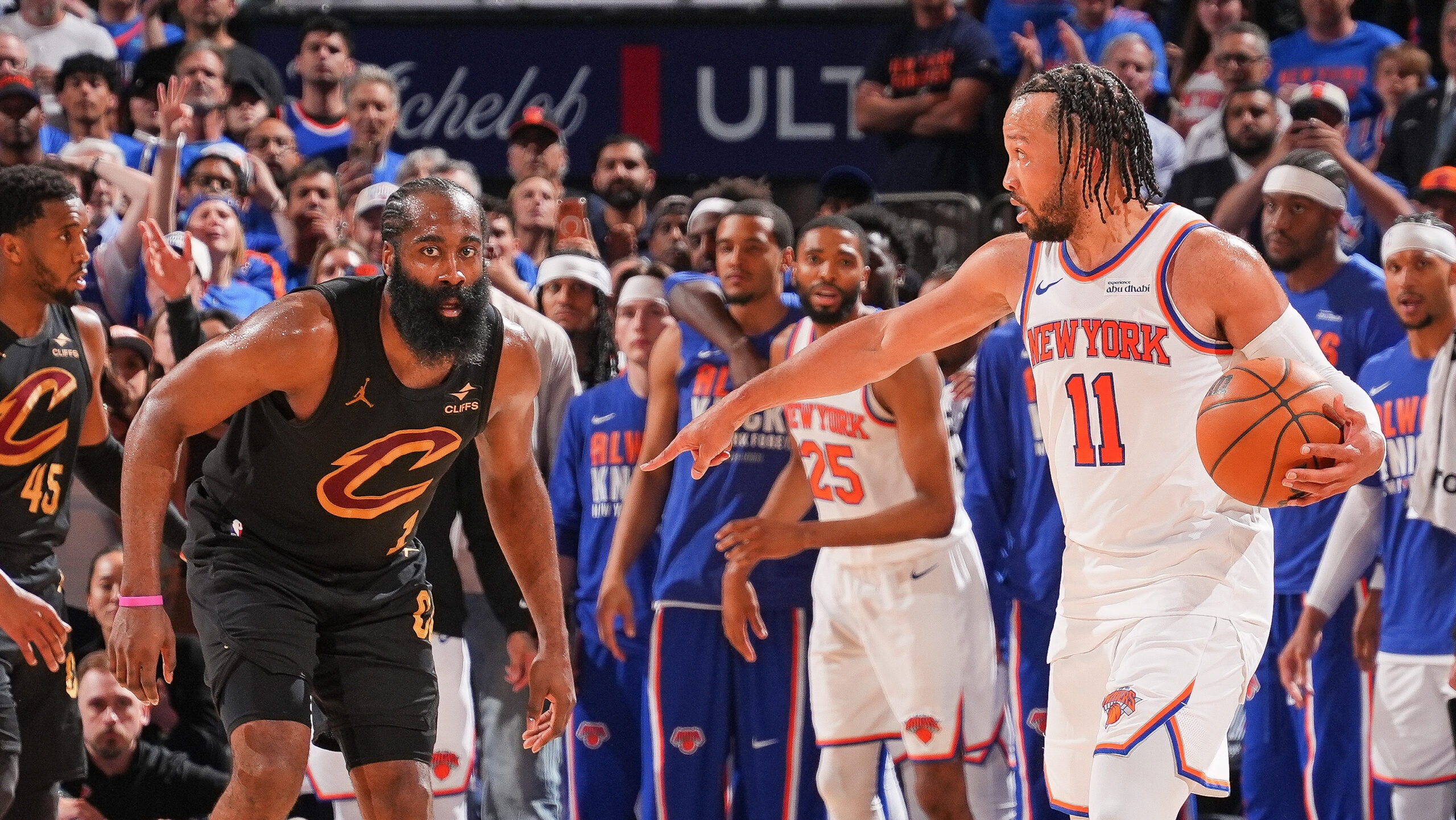
The blueprint for the Knicks' Game 1 comeback was clear: unleash Jalen Brunson on James Harden. From the moment Brunson started hunting Harden on almost every possession, the game fundamentally shifted.
New York meticulously engineered switches, isolating Brunson against Harden after a screen. The results were devastating. During the crucial final eight minutes of the fourth quarter and overtime, Brunson attacked Harden as the screener's defender on 20 occasions. The Knicks' offensive efficiency skyrocketed to 1.39 points per chance, converting 1.61 points per direct shot, turnover, or free-throw trip. Brunson's ability to create, whether driving or hitting tough contested shots, proved unstoppable.
The Cavaliers attempted adjustments, including "icing" screens to prevent Brunson from using them, hoping Harden could drop back and recover. However, Brunson's quick decision-making and the subsequent breakdown in Cleveland's defense led to other Knicks players like OG Anunoby finding driving lanes and drawing fouls. This cat-and-mouse game exposed Cleveland's defensive vulnerabilities, leaving them with no easy answers for Brunson's relentless assault.
The X-Factor: Landry Shamet's Perimeter Threat
While Brunson stole the headlines, the insertion of Landry Shamet into the lineup over Josh Hart proved to be a tactical masterstroke that unlocked New York's offense. When Shamet shared the court with the other four starters, the Knicks scored an astounding 1.76 points per offensive possession, a stark contrast to the 0.80 points per possession with Hart alongside the initial starting five.
Hart, despite his defensive prowess and rebounding, has struggled from beyond the arc in the playoffs, hitting just 27% of his three-pointers. This allows Cleveland's bigs, like Jarrett Allen, to sag off him and protect the paint. Shamet, however, is a different story, boasting an impressive 50% from three-point range in the playoffs after a perfect 3-for-3 in Game 1. His presence forces Cleveland's defenders to respect the perimeter, pulling their bigs out of the paint and creating crucial spacing for Brunson and others to operate.
This strategic switch transforms the Knicks into a five-out threat, making them significantly harder to guard. Expect to see Shamet earn extended minutes in Game 2 as New York looks to maintain this offensive advantage.
Cleveland's Offensive Puzzles: Capitalizing on Open Looks
Despite the heart-wrenching Game 1 loss, the Cavaliers actually generated higher quality looks than the Knicks for much of the game. Cleveland recorded an expected effective field-goal percentage of 54.9%, significantly higher than their actual 48.9%. Conversely, New York outperformed its expected 50.8% eFG%, hitting 53.4%. The Cavaliers had 16 corner three-point attempts, their highest of these playoffs, indicating their offense was creating opportunities.
The Knicks' defense often employs a strategy of temporarily putting two defenders on the ball-handler (like Donovan Mitchell or Harden) when screens involve Karl-Anthony Towns or Brunson. While this aims to prevent switches, it frequently leaves weak-side shooters open. Cleveland needs to be sharper in capitalizing on these created advantages.
Furthermore, Cleveland's offense can become stagnant, partly due to a lack of interior aggression from Evan Mobley. The Knicks are content to let Mobley roam on the perimeter, knowing his outside shot isn't a primary threat. Mobley attempted only six shots in the paint and just two free throws in Game 1. For Cleveland to even this series, Mobley must assert himself more offensively, driving into the paint and drawing fouls, thereby forcing New York's defense to adjust and open up more space for their perimeter shooters.