
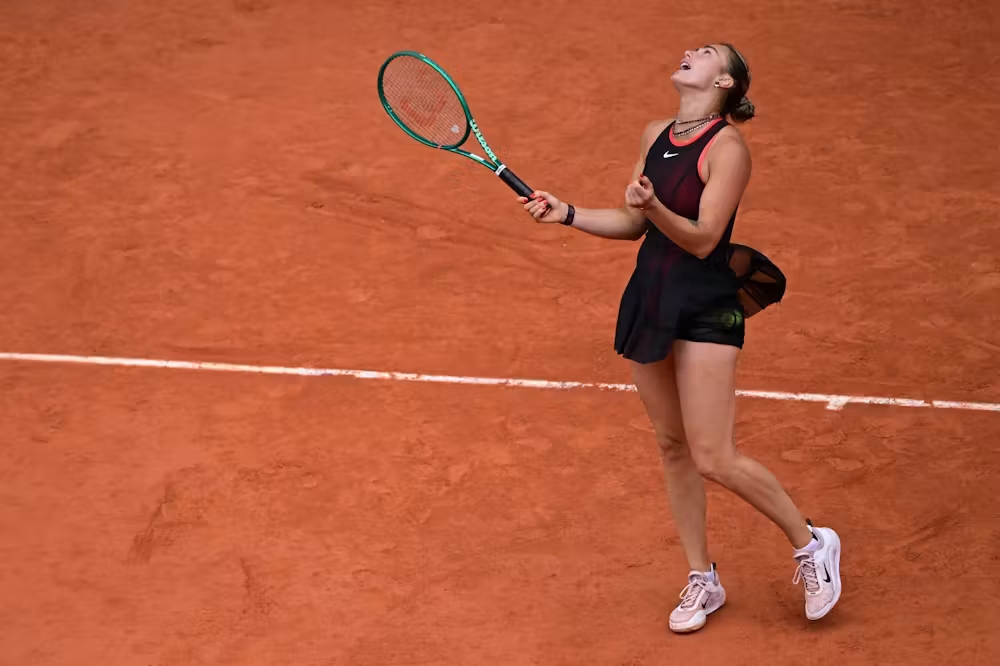

Aryna Sabalenka's Roland Garros campaign came to a shocking end after the world No. 1 squandered a commanding position against Diana Shnaider, leaving Paris once again facing questions about her ability to manage pressure in the biggest moments.
Sabalenka appeared firmly in control of her quarterfinal match, leading by a set and holding a 5-4 advantage in the second. With a place in the semifinals seemingly within reach, the Belarusian looked set to continue her pursuit of a third consecutive Grand Slam final appearance.
Instead, the match unraveled in dramatic fashion.
After failing to close out the contest while serving for the match, Sabalenka lost momentum completely. Shnaider seized the opportunity and stormed back to claim a remarkable 3-6, 7-5, 6-0 victory, with Sabalenka dropping 10 consecutive games during the collapse.
Speaking after the defeat, Sabalenka pointed to her emotional state as a major factor behind the loss.
"I am so tired of losing some matches because I was overemotional," she admitted.
While difficult weather conditions, including strong winds on Court Philippe-Chatrier, added to the challenge, Sabalenka refused to blame the conditions alone. Instead, she acknowledged that her inability to stay mentally composed proved costly when the pressure increased.
"Mentally, I wasn't really okay," she said.
The defeat continued a frustrating trend for the three-time Grand Slam champion, whose biggest setbacks have often come after holding winning positions.
Last year, Sabalenka suffered a painful defeat to Coco Gauff in the Roland Garros final despite entering the match as the favourite. Earlier this season at the Australian Open, she also let a final-set lead slip away against Elena Rybakina.
Despite maintaining her position as the world's top-ranked player and enjoying another strong season overall, Sabalenka's record in Grand Slam finals and decisive matches has continued to fuel discussion about the mental side of her game.
The disappointment was amplified by the opportunity that lay ahead in Paris.
Several leading contenders had already exited the tournament, leaving the draw more open than expected. With Iga Swiatek, Coco Gauff and Elena Rybakina no longer in contention, Sabalenka was widely viewed as the favourite to reach the final and potentially add another major title to her collection.
Instead, the opportunity slipped away.
The defeat also denied Sabalenka a semifinal meeting with surprise package Maja Chwalinska, a matchup many believed would have favored the world No. 1.
Despite the heartbreak, Sabalenka remains confident she can overcome the recurring issue that has surfaced in several of her biggest defeats.
"I've been through so many things and overcome so many things," she said. "I just have to figure out that little thing that is not working for me sometimes."
Her immediate plans remain unclear as attention begins to shift toward Wimbledon, but the 28-year-old ended her press conference with a touch of humor.
Joking about how she would recover from the disappointment, Sabalenka suggested spending time in one of the popular "rage rooms" where participants smash objects to relieve stress.
Whether through reflection, training or a day of breaking furniture, Sabalenka knows the next challenge is not physical. The world No. 1 still possesses the power and talent to win any tournament she enters. The task now is ensuring that when the pressure reaches its peak, her emotions do not stand in the way.