
When you’re practicing, nothing beats training with a good partner. You get real-time feedback on the effectiveness of your shots and varied ball response that help develop court coverage and anticipation. Simulating match conditions improves point construction, strategy and mental focus to prepare for the rigors of actual competition. Throw in some trash-talk and a post-workout beverage and there’s just no replacement for hitting the courts with a fellow traveler.
The Pongbot Pace S Pro ball machine wants to put that notion to the test.
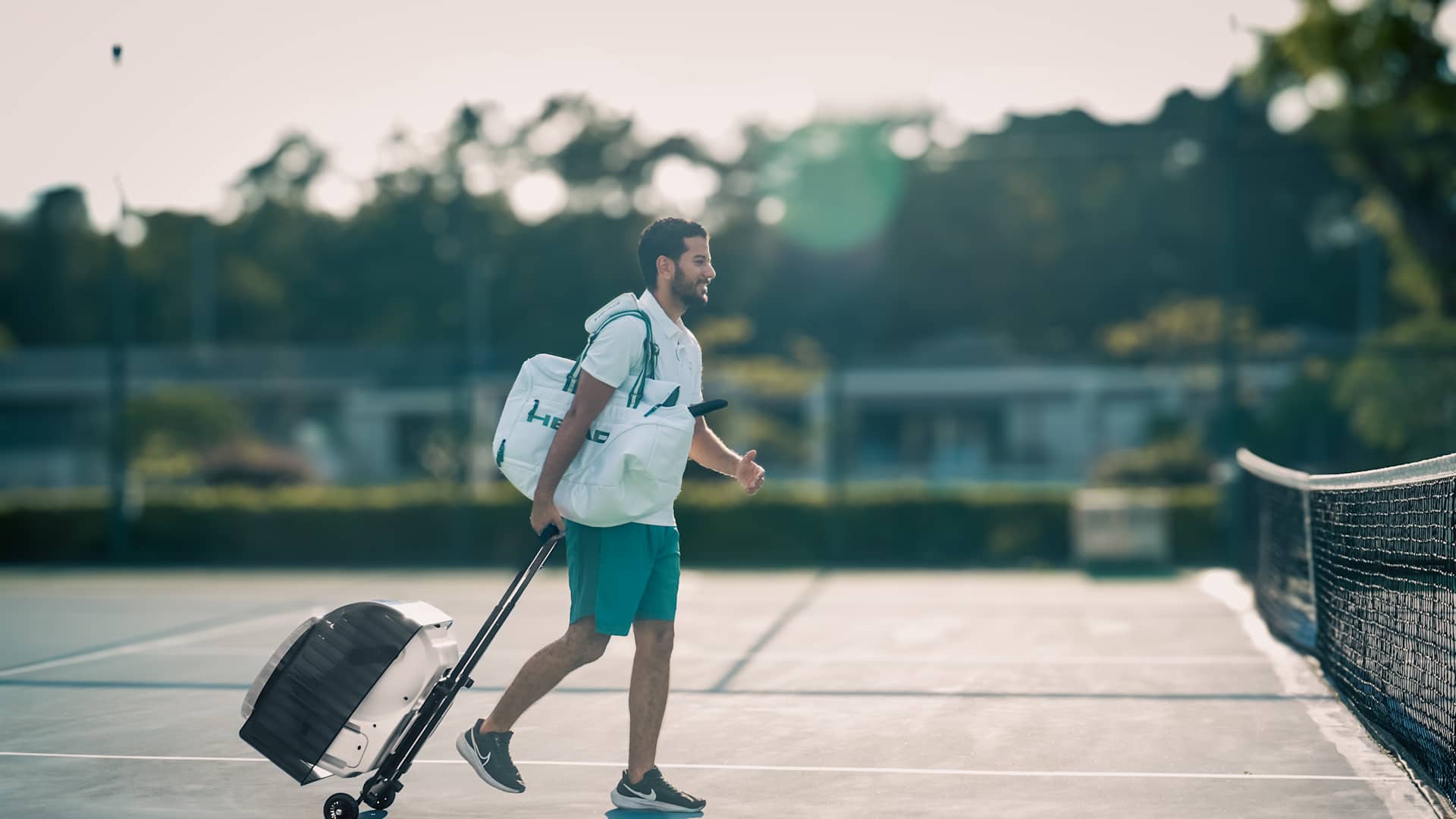
At first glance, the robot gives off a Stars Wars droid vibe. Not including its detachable ball hopper/cover, it has a modest footprint of roughly 19x17x13 inches and weighs a sturdy 45+ pounds. Metal grab handles on the bottom of both sides aid in lifting and carrying the machine in and out of a car trunk, but the process can be a bit awkward. Fortunately, it has a telescopic pull handle and luggage wheels that help transport it to and from the court.
It comes with a portable, rechargeable battery that offers up to eight hours of power. A small control panel on the side of the machine has an on/off switch, quick start/stop button and a USB port to charge to charge a smartphone or other devices. A robot remote control—which syncs with the accompanying app—operates the machine and has access to its full complement of features. Three smart trackers are used when engaging the AI capabilities. The remote and trackers can be recharged by the included 4-in-1 charging cable.
Once the Pongbot is in place and ammo is in its 150-ball capacity hopper, it’s ready to fire away. The machine can be operated by the portable remote, or the smartphone app which connects via Bluetooth. I found the app the more appealing option; it has a much bigger screen, easier access to the features and was less finicky with connectivity. However, it is rather comprehensive and requires a bit of learning curve.
There are 564 programmed drills that range from basic repeating ground strokes in a single location, to full-court, complex multi-shot combinations reflecting the user’s skill level. The machine can be placed at six different spots on the court to vary the feeding angles and possibilities. Balls quietly reach up to 80 MPH and 3600 RPMs, shot at a multitude of heights and locations. Feeds are as accurate and consistent as a Sinner backhand, jams are scarce—the only one I incurred was actually a false alarm—and balls are rarely leftover when the machine thinks it’s empty. The drills can be run for time or rounds.
There are 564 programmed drills that range from basic repeating ground strokes in a single location, to full-court, complex multi-shot combinations reflecting the user’s skill level. The machine can be placed at six different spots on the court to vary the feeding angles and possibilities. Balls quietly reach up to 80 MPH and 3600 RPMs, shot at a multitude of heights and locations. Feeds are as accurate and consistent as a Sinner backhand, jams are scarce—the only one I incurred was actually a false alarm—and balls are rarely leftover when the machine thinks it’s empty. The drills can be run for time or rounds.
While the built-in offerings are more than enough to keep you busy, custom drills take it to another level. This feature allows users to chalkboard their own drills up to 46 balls in a single sequence. You can plot the speed, spin, height, location and depth of every feed, or use preset shots from an extensive list broken down by shot type. If one of the shots needs tinkering in terms of timing or coordinates, editing is painless. I created a 9-ball drill—four groundies, an approach, two volleys and two overheads—that was textbook practice and a better workout.