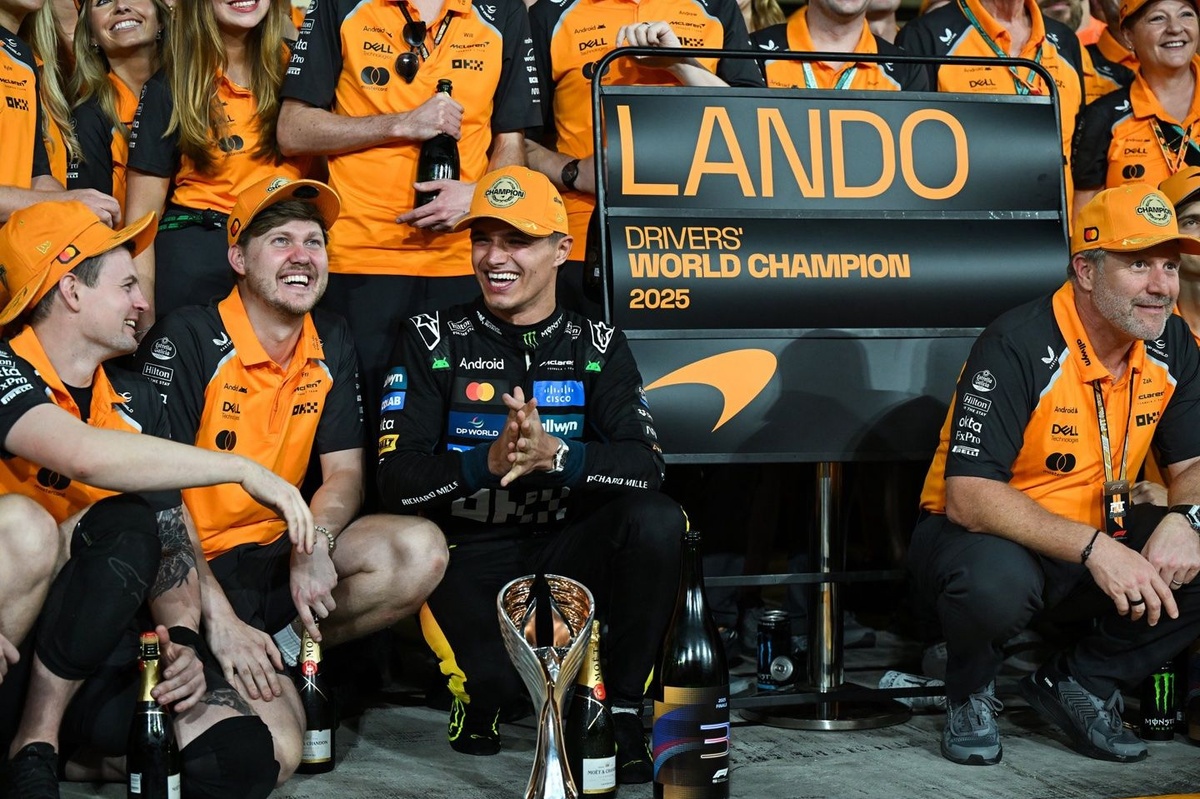



More than just identifying marks, Formula 1 driver numbers are deeply personal symbols, etched with history, superstition, and raw ambition. For the 2026 F1 season, these digits tell compelling stories, from reigning champions to promising rookies, revealing the intimate connections between drivers and their chosen identities.
Key Takeaways for the 2026 F1 Season
- Lando Norris proudly claims the iconic Number 1 as the new World Champion.
- Max Verstappen makes a significant shift to his childhood lucky number, Number 3.
- F1 rule changes now permit drivers to request number changes, adding a dynamic layer to identity.
- Each number on the grid carries a unique backstory, connecting drivers to their past and heroes.
The Crown and the Change: F1's Top Numbers
Lando Norris: The Reign of Number 1
The most coveted number in Formula 1 belongs to the reigning world champion, and for 2026, that's Lando Norris. After securing his first world title in Abu Dhabi 2025, the McLaren star immediately opted to swap his familiar #4 for the prestigious Number 1. This move underscores his achievement, taking over the mantle from Max Verstappen.
Norris articulated his decision to Sky Sports, stating, “The number is there for a reason: you have to fight for it, work hard to earn it. Everyone at McLaren – my mechanics, my engineers, everyone who is part of the team – can wear that number with pride too.” It’s a statement of collective triumph.
Max Verstappen's Bold Shift to Number 3
Having relinquished Number 1, four-time world champion Max Verstappen isn't reverting to his original #33. Instead, the Red Bull ace will race with Number 3 on his RB22 for 2026. This number became available after Daniel Ricciardo's departure from Formula 1 in mid-2024.
A recent relaxation in F1 regulations allowed Verstappen to make this change. Drivers can now submit requests to alter their permanent numbers, provided the number is available and receives approval. Ricciardo even gave his blessing, as he technically held the rights until mid-2026.
Verstappen always harbored a desire for Number 3, his lucky number from his younger racing days. "Number 33 was always fine, but I simply think one 3 looks better than two 3s," he explained to Viaplay. "Of course I always said it stood for double luck, but I’ve already had my luck in Formula 1."
Deep Meanings: Personal Legacies Behind F1 Numbers
Every driver on the grid has a personal narrative behind their chosen number, reflecting pivotal moments or cherished connections.
Gabriel Bortoleto: Number 5's Championship Legacy
Audi rookie Gabriel Bortoleto enters F1 with Number 5. This choice is a direct nod to his past success, as he famously clinched the FIA Formula 3 championship in 2023 while racing with the same digit. It’s a powerful symbol of his journey to the top tier.
Isack Hadjar: A Familiar Six on the Grid
Red Bull driver Isack Hadjar continues his career with Number 6. This number holds a special place, frequently used by Hadjar since his early karting days. Notably, his use marks a historical first: Number 6 has now been used by three different F1 drivers, following Nico Rosberg and Nicholas Latifi.
Pierre Gasly: The Champion's 10
Alpine's Pierre Gasly sports Number 10, a number associated with victory and heroes. He won the Formula Renault 2.0 Eurocup title in 2013 with this number. Furthermore, Gasly is a fervent admirer of football legend Zinedine Zidane, who famously wore number 10 for France.
Sergio Perez: The Undying Loyalty to 11
Returning to Formula 1 with Cadillac in 2026, Sergio Perez sticks with his cherished Number 11. This digit has been his consistent choice since 2014 and even graced his karts. The inspiration? Footballer Ivan Zamorano, who wore number 11 for Mexican club CF America, a team Perez admired.
Andrea Kimi Antonelli: Honoring an Icon with 12
Mercedes prodigy Andrea Kimi Antonelli debuts with Number 12. He revealed this choice is a tribute to an idol, Ayrton Senna, who raced with Number 12 between 1985 and his championship-winning 1988 season. Antonelli has also used #12 consistently since F4, a personal lucky charm.
Fernando Alonso: The Unbreakable Bond with 14
Aston Martin veteran Fernando Alonso races with Number 14, a number steeped in personal history. On July 14, 1996, at the age of 14, he became karting world champion driving a kart with Number 14. “From that moment on, I knew #14 was my number,” Alonso has stated, showcasing a deep, almost fated, connection.
Charles Leclerc: Calculated Luck with 16
Ferrari star Charles Leclerc bears Number 16. While his birthday is October 16, 1997, his primary choices of #7 (Kimi Raikkonen) and #10 (Pierre Gasly) were unavailable. His solution was a clever one: 1 plus 6 equals 7, his lucky number. A calculated choice for a meticulous driver.
Lance Stroll: Milestones and Number 18
Aston Martin's Lance Stroll drives with Number 18. This number resonates with significant milestones in his career: he won the Italian Formula 4 championship with it, and made his Formula 1 debut shortly after his 18th birthday. “I’m a little superstitious, but I like holding on to small things that are important to me,” the Canadian remarked.
Alexander Albon: Half of a Hero's Number, 23
Williams driver Alex Albon returns with the iconic Number 23. Famous in sports thanks to legends like LeBron James and Michael Jordan, and footballer David Beckham, Albon's inspiration comes from motorbike legend Valentino Rossi, who raced with #46. Albon humorously chose half of Rossi's number for his F1 career.
Nico Hulkenberg: The Simple Sum of 27
Upon his full-time F1 return, Audi's Nico Hulkenberg revived Number 27. For Hulkenberg, the choice is straightforward: adding the day and month of his birthday (August 19) results in 27. Sometimes, the simplest reasons are the most personal.
Liam Lawson: A Mentor's Legacy with 30
Racing Bulls driver Liam Lawson carries Number 30, a number with a touching backstory. He adopted it at eight years old, inspired by a karting mentor. "He became my hero, my idol, when I was still a little kid. He raced with Number 30. Because of him, I chose that race number too. He taught me everything about karting when I was young. I’ve basically used that number ever since,” Lawson shared.
Esteban Ocon: First Title, First Love: Number 31
Haas driver Esteban Ocon races with Number 31. This number is tied to one of his earliest triumphs, his first karting title win in 2007, a year he considers among his best. He also used #31 during his initial Formula 1 test with Lotus in 2014, cementing its significance.
Arvid Lindblad: Unique Identity in 41
Racing Bulls rookie Arvid Lindblad makes history as the first F1 driver to permanently choose Number 41. His reasoning is twofold: a desire for a unique number rarely seen in motorsport, and the symbolic resemblance of 41 to his initials, AL. A fresh number for a fresh talent.
Franco Colapinto: A Father's Footsteps with 43
Alpine's Franco Colapinto has raced with Number 43 since his 2024 F1 debut. While often associated with the late rally icon Ken Block, Colapinto's choice is deeply personal: his father used to race with it. He also secured karting and Spanish Formula 4 titles with #43, carrying on a family tradition.
Lewis Hamilton: The Unwavering 44
Seven-time world champion Lewis Hamilton remains steadfast with Number 44. This number originates from his very first karting races, when the young Lewis adopted the registration number from his father’s car: F44. Even when he held the right to wear #1 as world champion, Hamilton consistently stuck with his trusted 44, a testament to his roots and identity.
Carlos Sainz: The Creative #Carlo55ainz
Williams driver Carlos Sainz creatively chose Number 55. His explanation is as unique as the number itself: “The S in my first name looks like a five and the S in my surname does too, so that makes #55.” This ingenious wordplay also created his memorable social media hashtag, #Carlo55ainz. With #5 (his favorite) taken by Sebastian Vettel, 55 became his ingenious alternative.
George Russell: Family, Initials, and 63
Mercedes' George Russell races with Number 63, a family tradition. “My brother always karted with number 63, so since then it has become our family number,” Russell revealed. The number also cleverly represents his initials, GR, and for some, even GB for Great Britain.
Valtteri Bottas: Double the Luck with 77
Cadillac driver Valtteri Bottas returns to the grid in 2026 with his familiar Number 77. Initially considering just #7, he ultimately opted for the double-seven. "I just think it’s a nice number. I’m not really superstitious or anything like that,” Bottas explained, highlighting an aesthetic preference.
Oscar Piastri: The Genesis of 81
McLaren sensation Oscar Piastri chose Number 81, a nod to his karting beginnings. After starting with #11, he switched to #81 when #11 was unavailable. He consistently used it in various junior categories, cementing its place as his racing identity.
Oliver Bearman: A Family Tribute: 87
Haas driver Oliver Bearman chose the higher Number 87 for a heartwarming family reason. “I’ve raced with this number for many years, because my father was born on 8 May and my brother on 7 August. So, 87 is my favourite number,” he explained. A personal touch for a rising star.
Honoring a Legacy: The Retired Number 17
Formula 1 observes a poignant tradition: Race Number 17 is permanently retired. This is a solemn tribute to Jules Bianchi, who raced with that number at the time of his tragic accident at Suzuka in 2014. His passing led to this unprecedented honor, ensuring his memory remains etched into the sport's fabric.
Understanding F1's Number Regulations
The FIA's permanent number system, introduced in 2014, ensures drivers maintain a consistent identity. If a driver leaves F1, they retain the rights to their chosen number for two years. This allows for seamless returns, as seen with Fernando Alonso (#14), Alex Albon (#23), and Nico Hulkenberg (#27), who all reclaimed their old numbers. Should a longer absence occur, the driver must select a new number if their original choice has been claimed.