
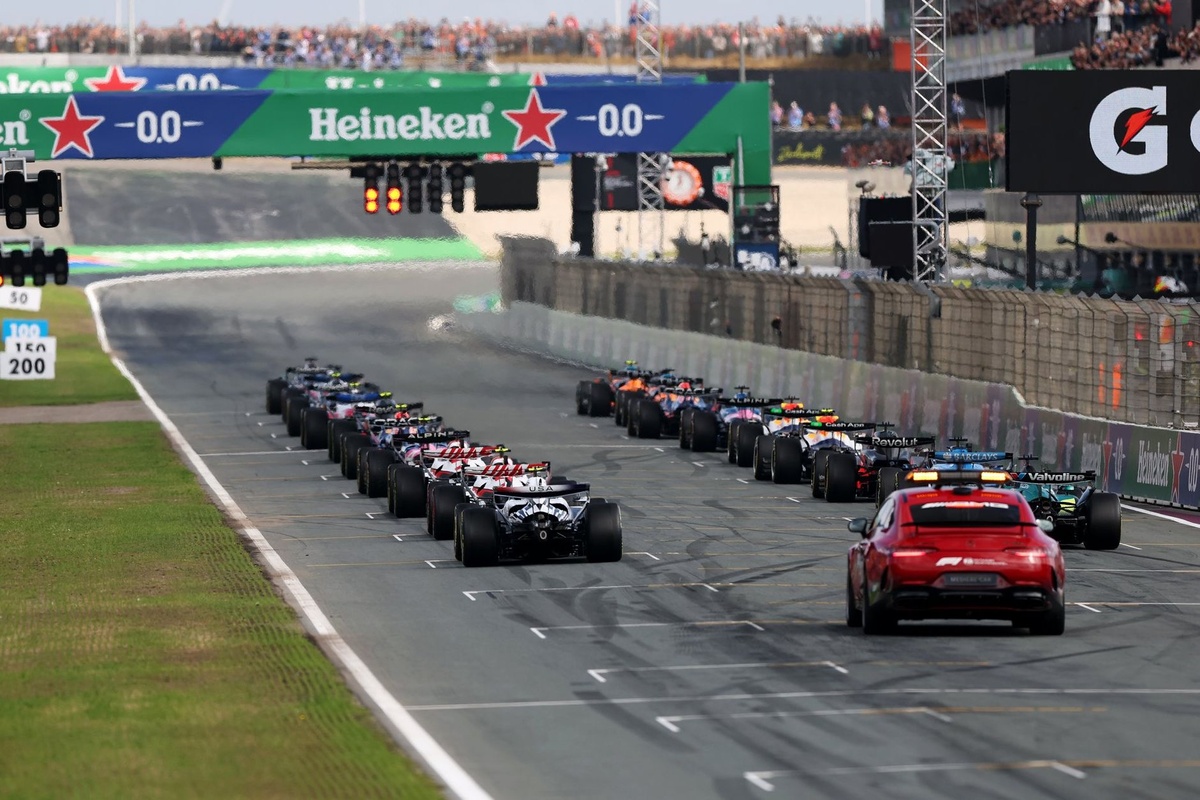

The Dutch Grand Prix at Zandvoort delivered instant drama, but not the kind anyone wanted. Rain during the grid procedure led to immediate chaos, sparking a heated debate among drivers about the FIA's controversial start protocol.
Key Points from Zandvoort's Chaotic Start
- Unexpected rain during the grid procedure transformed Zandvoort into a treacherous track.
- Max Verstappen crashed on Lap 1, openly admitting his own mistake on a wet final corner.
- Drivers including Pierre Gasly and Liam Lawson criticized the mixed start procedure, which featured a safety car formation lap followed by a standing start.
- The FIA defended its decision, citing reconnaissance by the medical car that reported significant standing water on parts of the circuit.
Zandvoort's Opening Mayhem: Verstappen's Misstep
The Dutch Grand Prix start was pure pandemonium. As rain fell over Zandvoort, the track became a minefield. Home hero Max Verstappen found himself in the thick of it, crashing heavily on the exit of the final corner on the opening lap.
"It was entirely my own mistake," Verstappen admitted post-race. He had misjudged the grip, getting back on the throttle while the final corner was still wet. Just behind him, Gabriel Bortoleto miraculously kept his Audi out of the wall, while teammate Nico Hulkenberg narrowly avoided a potential T-bone collision.
Bortoleto explained that the rest of the circuit had already dried, leaving the final corners as the main challenge. "It was just that corner, if I'm very honest with you. It was full wets, that place. I think that's why Max lost it and it was the same for me," Bortoleto said.
The Audi driver was running on the downside of the banking when he saw smoke ahead and reacted to the developing incident. However, his reaction move to the left also sent his car towards the danger.
Drivers United: Questions Over FIA's Start Procedure
The drivers were quick to voice concerns over the FIA's handling of the wet start. Many felt that completing a safety car formation lap before immediately opting for a standing start was an unnecessary risk.
With much of the track already dry, drivers believed starting on slick tyres made sense. However, several argued that a normal formation lap would have allowed them to assess the conditions more effectively and build more tyre temperature before the race began.
Gasly and Lawson Lead the Charge
Pierre Gasly questioned the decision to combine a safety car formation lap with a standing start. "If we would go the way we did with one lap behind the safety car and a standing start, then I would have preferred to just do a normal out-lap, so we would have pushed a bit faster," the Alpine driver said.
Gasly believed the purpose of the safety car lap was to allow drivers to pass through the final corner and banking before the race began. Since those areas were still damp, he felt the procedure could have been handled differently.
The Frenchman suggested the FIA should have chosen between two more conventional options: either a rolling start behind the safety car or a standing start preceded by a normal formation lap. "I'm sure we'll review at the next race what the drivers' feedback was," Gasly added. "But I think it was either no safety car and only one formation lap or with the safety car at least giving us one extra lap."
Red Bull stand-in Liam Lawson echoed Gasly's concerns and admitted he expected the unusual procedure to create problems before the race had even started. The New Zealander added that the potential for chaos was already obvious to the drivers before the start, although they had no control over the decision.
FIA Explains Why the Safety Car Was Used
Despite the criticism, the FIA defended its decision and explained that race control had acted based on the information available at the time. The race director initially sent the medical car out for a reconnaissance lap, which an FIA spokesperson said was not something that normally happens.
The medical car reported standing water at Turns 2 and 3, with Turn 3 — the Hugenholtz corner — also being the first banked corner of the circuit. Based on that information, the FIA considered it safer to conduct the formation lap behind the safety car.
The original intention was still to have a standing start. However, completing the formation lap behind the safety car allowed race control to keep both options available. If the standing water had been considered too dangerous, officials could still have switched to a rolling start.
Sainz Questions Whether a Rolling Start Would Have Helped
Not every driver believed changing the start procedure would have prevented the opening-lap drama. Williams driver Carlos Sainz argued that a rolling start may have produced a similar outcome because the wet section came towards the end of the lap.
"I think, given it was towards the end of the lap, a non-standing start, a rolling start, would have ended up in the same result, because by that time we were all one by one," Sainz said.
The Williams driver therefore felt that changing from a standing to a rolling start would not have made much difference, describing the situation as an unfortunate consequence of having a large amount of water concentrated in just one corner.
Lawson Took a More Cautious Approach
Ultimately, the conditions left drivers to make their own judgement about how much risk to take. Lawson explained that he deliberately left considerably more margin through the wet section than Verstappen, who was running ahead of him. "It was just impossible. The whole first half of the lap was dry and then the last few corners were completely soaked," Lawson said.
He explained that the combination of a powerful F1 car and slick tyres made it particularly easy to lose control in those conditions. Lawson therefore lifted off the throttle because he had little confidence in how much grip remained available. Lawson believed Verstappen may have been trying to close the gap and set up an overtake when he lost control.
Verstappen Takes Full Responsibility
Despite the unusual conditions and the debate surrounding the FIA's start procedure, Verstappen himself refused to point the finger elsewhere. The four-time world champion maintained that the crash was simply his own mistake, accepting responsibility for getting back on the throttle at a part of the track that was still too wet.
While the opening lap at Zandvoort triggered questions about the FIA's decision-making, the drivers' differing opinions highlighted just how difficult the conditions were to judge, with the majority of the circuit dry but the final corners remaining dangerously wet.